
Last updated: June 12, 2026
Quick Answer
Senator Chuck Schumer told reporters this week that he still wants Congress to pass artificial intelligence legislation, but admitted it will be “hard” in this Congress because of splits over kids’ online safety, federal preemption of state AI laws, and how aggressively to brake AI development [1]. His current agenda pushes a stream of narrower bills (rather than one omnibus) that keep “innovation strong” while adding guardrails, even as the White House, progressives, and committee chairs each pull the conversation in different directions [1][4].
Key Takeaways
Schumer is pushing several smaller AI bills through committees instead of one giant law [1][4].
The White House under President Trump is now pressing for federal AI rules that would override state laws, complicating Senate negotiations [1][3].
The Senate Banking Committee held a hearing this week on AI, affordability, and U.S. dominance, operationalizing Schumer’s 2024 roadmap [2].
Progressives like Senator Bernie Sanders and Rep. Alexandria Ocasio-Cortez want a moratorium on new AI data centers [1].
A bipartisan House effort by Reps. Trahan and Obernolte has stalled over preemption disputes [1].
Civil society groups remain critical of Schumer’s 2024 roadmap, calling it too friendly to Big Tech and defense interests [5].
A Senate AI bill just advanced out of committee on a 16–12 vote, showing slow but real movement [4].
What exactly is Schumer proposing for AI regulation?
Schumer is not proposing one sweeping AI law. He is shepherding a series of narrower bills that target specific problems (election deepfakes, child safety, R&D funding, workforce training) while letting standing committees handle issues in their jurisdictions [1][4].
In a June 2026 interview, Schumer said any bill must “keep innovation strong, but have guardrails to prevent the dangers” [1]. That framing comes directly from the May 2024 bipartisan AI roadmap, Driving U.S. Innovation in Artificial Intelligence, which called for roughly $32 billion in non-defense AI R&D and asked committees to write the actual statutes [8][9].
The current pieces in motion include:
A Senate AI bill that cleared committee on a 16–12 vote and awaits House action [4].
Possible kids’ online safety legislation with AI provisions attached [1].
Workforce, energy, and data center bills moving through Commerce, Banking, and Energy committees [2][4].
Decision rule: If you’re tracking what becomes law, watch committee markups, not floor speeches. Schumer’s strategy depends on chairs (not him) producing text.
How does Schumer’s AI agenda compare to other countries’ AI policies?
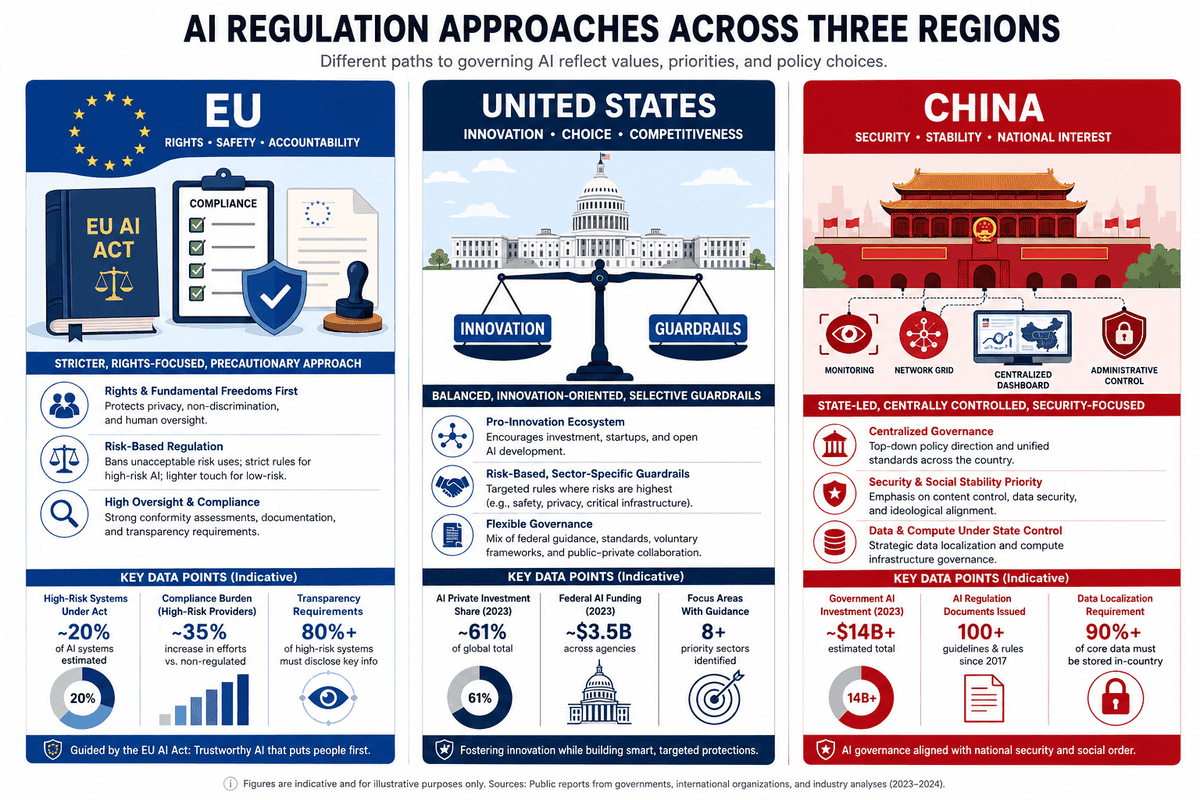
The U.S. approach under Schumer is lighter, slower, and more sector-by-sector than the EU’s, and more market-friendly than China’s state-led model. There is still no single federal AI law in the United States [8][10].
RegionApproachStatusEuropean UnionRisk-tiered, horizontal AI Act covering all sectorsIn force, phased rolloutUnited States (Schumer track)Multiple narrow bills + executive ordersBills moving piecemeal [1][4]ChinaState-directed, with mandatory algorithm registrationActive enforcementUnited KingdomPrinciples-based, regulator-ledVoluntary, evolving
The Brookings Institution noted that the Schumer roadmap deliberately avoids a comprehensive statute and instead pushes committees and agencies to act, which is closer to the U.K. model than to Brussels’ [10].
What tech companies are supporting or opposing Schumer’s AI plan?
Large AI labs and cloud providers have generally backed Schumer’s “innovation plus guardrails” framing because it avoids EU-style horizontal rules and includes heavy R&D funding [8][9]. Civil society groups and some smaller competitors are the loudest critics [5].
Generally supportive: Major AI labs, large cloud providers, defense-tech firms, and chip companies that benefit from the proposed $32 billion R&D push [8].
Critical or cautious: Civil rights groups, the Open Markets Institute, and academics who say the roadmap entrenches dominant firms and underplays bias and accountability [5].
Pushing for stricter rules: Some labor unions, consumer protection groups, and progressive lawmakers calling for a data center moratorium [1].
Courtney Radsch of Open Markets Institute warned that funneling $32 billion in R&D “risks further entrenching dominant firms” that already control chips, compute, cloud, and talent [5].
Will these proposed AI rules impact startups or just Big Tech?
Both, but unevenly. Compliance costs, audit requirements, and transparency mandates tend to hit small AI startups harder per dollar of revenue, while Big Tech can absorb them more easily. Federal preemption of state laws (a key fight right now) would actually simplify life for startups operating in multiple states [1].
If you run an AI startup, three provisions matter most:
Transparency and disclosure rules (model cards, training data summaries).
Liability allocation between model developers and downstream deployers.
Preemption of California, Colorado, New York, and Texas state AI laws.
Choose your stance based on size: Early-stage startups generally favor federal preemption (one rulebook). Mid-size firms often prefer state flexibility.
What specific risks is Congress most worried about with AI?
Congress is focused on six risks: election deepfakes, child safety, job displacement, national security, AI-enabled cybercrime, and concentration of market power [1][3][5]. Bias in housing, lending, and employment gets less airtime, which critics say is a major blind spot [5].
Spencer Overton of GW Law pointed out that Schumer’s roadmap used the word “bias” only three times in roughly 30 pages, twice in an appendix [5]. That is one reason civil rights groups say the agenda underweights everyday harms that affect millions of Americans.
President Trump’s June 2026 executive order on “Promoting Advanced Artificial Intelligence Innovation and Security” directs the Department of Justice to prioritize prosecutions of AI-enabled hacking and computer crime, setting a tougher federal enforcement backdrop [3].
How might these potential regulations affect the AI development timeline?
Most analysts expect modest near-term slowdowns and bigger long-term compliance costs, not a halt. The fragmented, bill-by-bill approach Schumer favors means companies face uncertainty rather than a single shock [1][4].
Likely effects over the next 18–24 months:
More documentation and red-teaming required for frontier models.
Slower data center buildouts if Sanders-AOC moratorium ideas gain traction [1].
Faster federal procurement of trusted AI tools after the Trump executive order [3].
Continued state-level action (California, Colorado) unless preemption passes [1].
What are the key differences between Democratic and Republican views on AI oversight?
Republicans generally emphasize innovation, China competition, and avoiding “trampling states’ rights,” while Democrats are more divided — some want strong federal rules, others (progressives) want even stricter limits including moratoriums [1]. Bipartisan agreement exists on national security, R&D funding, and child safety [1][8].
Where they split:
Preemption of state AI laws: Many Republicans worry about federal overreach; some Democrats oppose preemption that weakens California-style rules [1].
Civil rights enforcement: Democrats push harder on bias audits; Republicans prefer voluntary standards [5].
Data center moratorium: A progressive Democratic proposal; opposed by most Republicans and many moderate Democrats [1].
Liability: Democrats lean toward developer liability; Republicans toward deployer responsibility.
Opposition from key Democrats has recently slowed a House effort by Reps. Lori Trahan (D-MA) and Jay Obernolte (R-CA) to craft a nationwide AI safety and transparency bill, showing that intra-Democratic splits are now the bigger obstacle than the partisan divide [1].
Could these proposed rules slow down AI innovation in the U.S.?
Probably yes at the margins, but not dramatically if Schumer’s narrow-bill strategy holds. Elon Musk, after a 2023 Senate AI forum, said there was “overwhelming consensus” on the need for regulation [6], and most large AI firms now publicly support targeted rules as a way to lock in their position.
The bigger innovation risks are:
Patchwork of state laws if federal preemption fails [1].
Export controls and chip restrictions tightening under the Trump order [3].
Energy and data center permitting fights delaying infrastructure [1].
What kind of penalties are being discussed for AI companies that don’t comply?
Discussions range from civil fines and disclosure mandates to criminal prosecutions for AI-enabled crimes. The Trump executive order specifically directs DOJ to prioritize prosecutions of AI-enabled hacking [3]. Schumer’s committee-driven bills are more likely to use civil penalties, FTC enforcement, and licensing requirements for high-risk applications [4][8].
Categories under consideration:
Civil fines tied to revenue (EU-style, but smaller).
Mandatory disclosures for synthetic media in elections.
Criminal liability for AI-enabled fraud, CSAM, and cyberattacks [3].
Procurement bans for non-compliant vendors selling to the federal government.
Who are the main AI experts testifying to Congress this week?
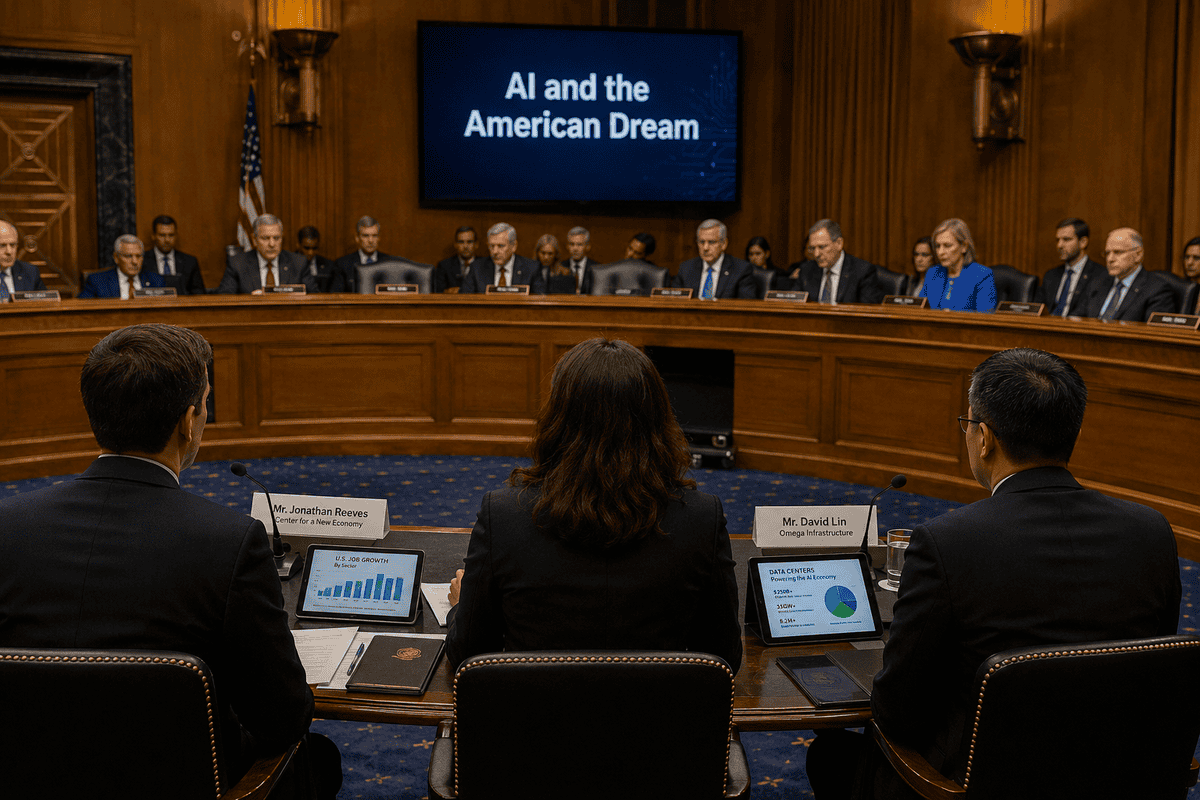
This week’s most visible hearing was the Senate Banking, Housing, and Urban Affairs Committee session titled “AI and the American Dream: Promoting Innovation, Affordability, and American Dominance” [2]. Industry executives, economists, and consumer advocates testified on AI’s impact on housing affordability, jobs, and data center siting.
Earlier rounds of Senate AI testimony have included executives from major labs, academics like Suresh Venkatasubramanian (Brown University), and former Biden-Harris advisor Dr. Alondra Nelson, who led the AI Bill of Rights work [5]. Nelson has been sharply critical, saying the Schumer roadmap was “stripped of our shared values of public benefit, corporate accountability, and protections of our fundamental rights and liberties” [5].
How will these potential regulations impact AI jobs and workforce?
Expect a mix: more compliance, audit, and safety roles; pressure on routine cognitive jobs; and federal funding for retraining. The Senate Banking hearing this week explicitly probed witnesses on AI’s effect on jobs and affordability [2].
Likely workforce shifts:
Growth in AI governance, audit, and red-team roles.
Continued demand for ML engineers and data center operators.
Displacement risk in customer service, paralegal work, junior coding, and content moderation.
Federal retraining funds tied to AI R&D appropriations [8].
What are the potential economic implications of strict AI oversight?
Tighter oversight would likely raise short-term compliance costs, slow some deployments, and shift investment toward larger firms that can absorb the burden. It would also reduce certain externalities (fraud, election manipulation, discrimination) that themselves carry economic costs [5][6].
The White House’s March 2026 National Policy Framework for Artificial Intelligence signals that the administration wants federal rules that protect U.S. competitiveness while standardizing the playing field [7]. Schumer’s challenge is aligning Senate Democrats with that framework without alienating progressives or civil society [1][5].
Sectors like banking, which are already deploying generative AI for fraud detection, underwriting, and customer service, are likely to face some of the earliest compliance scrutiny under any new federal framework – see our breakdown of Top 12 Generative AI in Banking Use Cases for where adoption is heaviest.”
FAQ
Q: Is Schumer’s AI agenda going to become law in 2026?
A: Schumer himself says it will be “hard” this Congress [1]. Expect narrow bills (election deepfakes, kids’ safety) to have the best odds, not a comprehensive law.
Q: What is the Schumer AI roadmap?
A: A May 2024 bipartisan document, Driving U.S. Innovation in Artificial Intelligence, that called for $32 billion in annual non-defense AI R&D and asked Senate committees to draft specific bills [8][9].
Q: Does the White House support Schumer’s approach?
A: Partly. The Trump White House wants federal preemption of state AI laws and tougher AI crime enforcement, which overlaps with but is not identical to Schumer’s plan [1][3].
Q: What is federal preemption and why does it matter?
A: Preemption means a federal AI law would override state AI laws like California’s. It’s the single biggest fight in Congress right now [1].
Q: Who opposes the Schumer roadmap?
A: Civil society groups, academics like Suresh Venkatasubramanian and Alondra Nelson, and organizations like Open Markets Institute argue it favors Big Tech and defense interests [5].
Q: Are progressives proposing alternatives?
A: Yes. Sen. Bernie Sanders and Rep. Alexandria Ocasio-Cortez have proposed a moratorium on new AI data centers until stronger oversight is in place [1].
Q: How does the U.S. compare to the EU on AI rules?
A: The EU has a comprehensive AI Act in force. The U.S. has no equivalent and is unlikely to get one soon [10].
Q: What should businesses do now?
A: Track committee markups (not floor speeches), document AI use cases, prepare model documentation, and follow both federal and state developments [4].
Conclusion
Schumer’s AI agenda this week reflects a Congress still trying to balance speed, safety, and competitiveness without a clear majority for any single approach. The pieces are moving — a Senate bill out of committee on a 16–12 vote [4], a major Banking Committee hearing [2], a Trump executive order on AI crime [3], and active fights over preemption and a possible data center moratorium [1].
Actionable next steps:
For policy watchers: Monitor Senate Commerce, Banking, and Judiciary committee markups, not floor speeches.
For startups: Begin documenting model cards, training data sources, and risk assessments now — federal rules will likely require them.
For job seekers: Build skills in AI governance, audit, and red-teaming; these roles will grow regardless of which bills pass.
For citizens: Read Schumer’s roadmap and the AI Bill of Rights, then contact your senators on the specific provisions you care about.
The fight over Schumer’s AI agenda is no longer about whether to regulate AI — it’s about who writes the rules and whose interests they protect.
References
[1] Chuck Schumer AI Congress – Politico – https://www.politico.com/live-updates/2026/06/12/congress/chuck-schumer-ai-congress-00960335
[2] Watch Live: Senate Hearing on AI Affordability and Innovation – The Hill – https://thehill.com/video-clips/5919720-watch-live-senate-hearing-ai-affordability-innovation/
[3] Promoting Advanced Artificial Intelligence Innovation and Security – White House – https://www.whitehouse.gov/presidential-actions/2026/06/promoting-advanced-artificial-intelligence-innovation-and-security/
[4] AI Legislative Update June 12, 2026 – Transparency Coalition – https://www.transparencycoalition.ai/news/ai-legislative-update-june12-2026
[5] US Senate AI Report Meets Mostly Disappointment and Condemnation – Tech Policy Press – https://techpolicy.press/us-senate-ai-report-meets-mostly-disappointment-condemnation
[6] Overwhelming Consensus for AI Regulation, Musk Says After Senate Forum – PBS – https://www.pbs.org/newshour/politics/watch-overwhelming-consensus-for-artificial-intelligence-regulation-musk-says-after-senate
[7] National Policy Framework for Artificial Intelligence Legislative – White House – https://www.whitehouse.gov/wp-content/uploads/2026/03/03.20.26-National-Policy-Framework-for-Artificial-Intelligence-Legislative
[8] AI Schumer Roadmap Congress – The New York Times – https://www.nytimes.com/2024/05/15/technology/ai-schumer-roadmap-congress.html
[9] Senate AI Working Group Releases Roadmap for AI Policy – Mayer Brown – https://www.mayerbrown.com/en/insights/publications/2024/05/senate-ai-working-group-releases-roadmap-for-artificial-intelligence-policy
[10] What to Make of the New AI Roadmap from the Senate’s Bipartisan Commission – Brookings – https://www.brookings.edu/articles/what-to-make-of-the-new-ai-roadmap-from-the-senates-bipartisan-commission-the-techtank-podcast/

Shivakumar K Naik is an SEO Analyst and Technology Writer based in Mysore, Karnataka with 2.5+ years of experience and 28+ client success stories across FinTech, Travel, Automotive, SaaS and Education. He has delivered 150+ Google first-page rankings for brands like Mudrex, Decathlon and Maruti Suzuki. On Tech Caffeine, he writes practical, beginner-friendly guides on AI tools, how to make money online with AI, cryptocurrency, blockchain, NFTs, gaming and emerging technology content built from real SEO experience and daily hands-on use of ChatGPT, Claude, Ahrefs and Semrush.