

Last updated: June 21, 2026
Quick Answer: A neural network is a type of machine-learning model made of connected layers of simple units called neurons. It learns patterns from data by adjusting numbers called weights. It can recognize images, understand text, predict demand, and power tools like ChatGPT – all without being told the rules in advance.
Key Takeaways
- A neural network is a machine-learning model, not an actual brain – it’s inspired by biology but runs on math.
- Every neuron follows one simple rule: multiply inputs by weights, add a bias, then pass the result through an activation function.
- Networks learn by guessing, measuring how wrong they were, and nudging weights slightly repeated millions of times (this is called backpropagation).
- Different problems need different network types: images use CNNs, text uses transformers, tables use simple feedforward networks.
- Deep learning just means a neural network with many hidden layers.
- Neural networks need large amounts of data and significant computing power to train well.
- Tools like Keras and PyTorch let beginners build a working model with basic coding skills.
- ChatGPT is built on a neural network type called a transformer.
TL;DR – Summary
Who should read what:
- Total beginner → read top to bottom
- Semi-technical → jump to the worked example and type-selection table
- Just need a definition → you already have it above
What Is a Neural Network?
A neural network is a machine-learning model made of connected layers of simple units called neurons that learns to recognize patterns in data by adjusting numbers called weights and biases – no hand-written rules required.
That’s the core definition. Everything else in this guide builds on it.
One important caveat upfront: neural networks are inspired by the human brain, but they are not brains. They are math running on computers. More on that myth later.
How Does a Neural Network Actually Work?
A neural network takes inputs, passes them through layers of neurons that each do a tiny calculation, and produces an output like a label or a prediction.
Think of it as a chain of switchboard operators. Each operator receives signals from the previous row, decides how loudly to pass each signal forward, and hands the result to the next row. By the time the signal reaches the last operator, the network has made a decision – “this email is spam” or “this photo contains a cat.”
No single operator is smart. But together, thousands of them can solve surprisingly hard problems.
The One Rule Every Neuron Follows
Every neuron in every neural network follows the same two-step rule.
Step 1 – Weighted sum:
z = w₁x₁ + w₂x₂ + … + b
In plain words:
- x = the inputs (the data coming in, like pixel brightness or word frequency)
- w = a weight – think of it as a volume knob for each input (higher weight = that input matters more)
- b = a bias – a fixed nudge that shifts the result up or down, like a thumb on a scale
- z = the raw total before any final decision
Step 2 – Activation function:
a = f(z)
In plain words: take that raw total z and pass it through a small rule (the activation function) that decides what signal to send forward. This is what lets the network learn curved, complex patterns instead of just straight lines.
That’s it. That’s the whole rule. Every neuron, in every network, in every AI system, follows this exact pattern.
A Worked Example With Real Numbers
Here is one neuron doing real math. No shortcuts.
Setup:
- Input 1: x₁ = 2
- Input 2: x₂ = 3
- Weight 1: w₁ = 0.5 (this input gets half-volume)
- Weight 2: w₂ = −1 (this input gets flipped and full-volume)
- Bias: b = 1
Step 1 – Calculate z:
z = (0.5 × 2) + (−1 × 3) + 1
z = 1 + (−3) + 1
z = −1
Step 2 – Apply ReLU (the activation function):
ReLU stands for Rectified Linear Unit. Its rule is simple: if z is below zero, output 0. If z is zero or above, output z as-is.
z = −1, which is below zero, so: output = 0
This neuron fires nothing. It stays silent. In a real network, that silence is useful information – it tells the next layer “this pattern wasn’t present here.”
When I explain this to beginners, the part that clicks is realizing that a neuron isn’t doing anything mysterious. It’s just multiplying, adding, and then applying a simple rule. The magic comes from doing this thousands of times, across many layers, with the weights slowly improving.
From One Neuron to a Whole Network
A single neuron can only detect one simple pattern. But stack hundreds of neurons into a layer, then stack multiple layers on top of each other, and the network can detect complex patterns.
The first layer might detect simple things (like bright edges in a photo). The next layer combines those to find shapes. The layer after that combines shapes into objects. By the final layer, the network can say “this is a cat” – even though no one ever wrote a rule defining what a cat looks like.
What Are the Parts of a Neural Network?
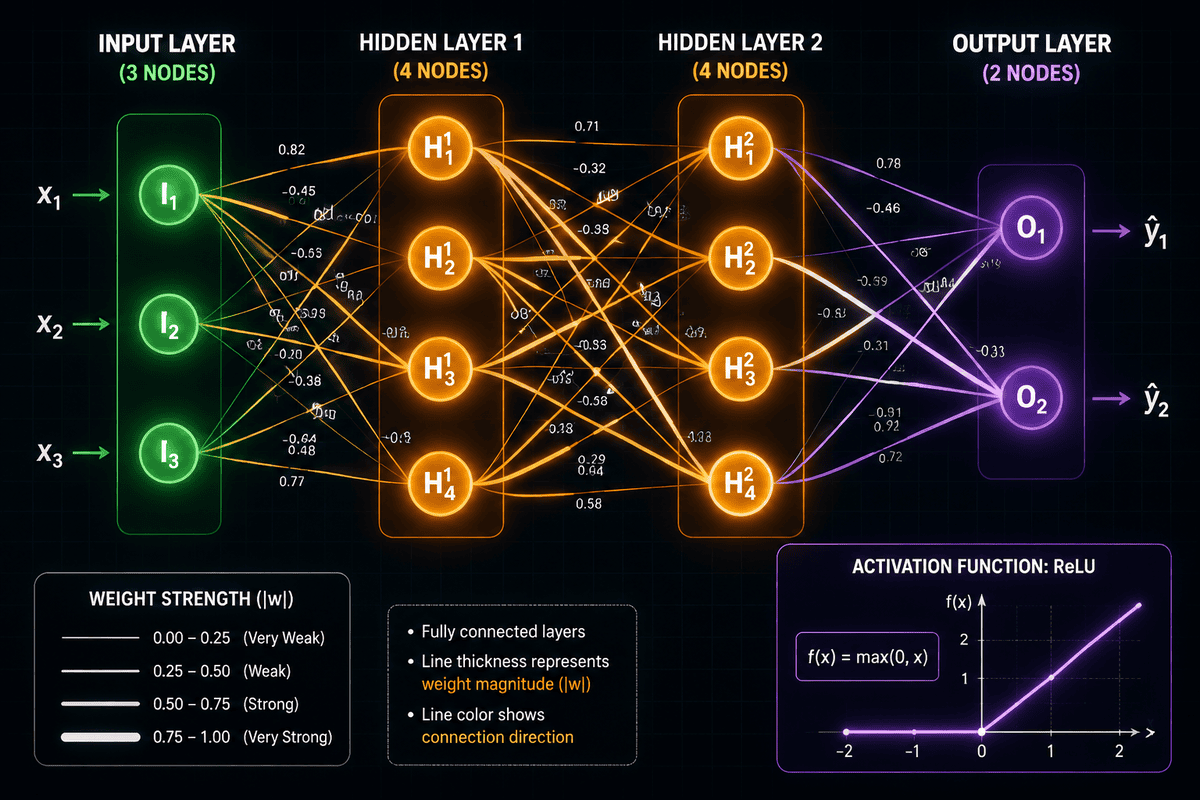
Every neural network has five core parts: neurons, layers, weights, biases, and activation functions.
Here is what each one does:
- Neuron (also called a node): The basic unit. It receives inputs, does the weighted-sum calculation, and passes a result forward.
- Input layer: The first layer. It receives the raw data – pixel values, word counts, temperature readings, whatever the problem needs.
- Hidden layer: Any layer between the input and output. This is where the network learns internal patterns. More hidden layers = deeper network = “deep learning.”
- Output layer: The final layer. It produces the answer – a category, a number, a probability.
- Weight: A number attached to each connection between neurons. It controls how much influence one neuron has on the next. The network learns by changing these.
- Bias: A single extra number added to each neuron’s calculation. It lets the neuron shift its output even when all inputs are zero.
- Activation function: A small math rule applied after the weighted sum. It adds the “bend” that lets the network learn non-straight-line patterns.
What Is an Activation Function (and Why You Can’t Skip It)?
Without an activation function, stacking 100 layers is mathematically identical to having just one layer. The activation function is what gives each layer the ability to learn something genuinely different from the layer before it.
Here are the four most common activation functions:
| Function | Output Range | Plain-English Job | When It’s Used |
|---|---|---|---|
| ReLU | 0 to ∞ | “Off below zero, on above zero” | Most hidden layers in CNNs and MLPs |
| Sigmoid | 0 to 1 | Squashes any number to a probability | Binary yes/no output layer |
| Softmax | 0 to 1 (all sum to 1) | Picks one winner from many classes | Multi-class output layer |
| Tanh | −1 to 1 | Centered version of sigmoid | Some hidden layers in older networks |
A practical note for 2026: ReLU remains the default for hidden layers in feedforward and CNN architectures. Many modern transformer-based models (like those powering large language models) use a variant called GELU instead – but the concept is the same.
How Do Neural Networks Learn?
A network learns by guessing, checking how wrong it was, and nudging its weights to be a little less wrong – repeated millions of times.
This process has four steps: forward propagation, loss calculation, backpropagation, and gradient descent.
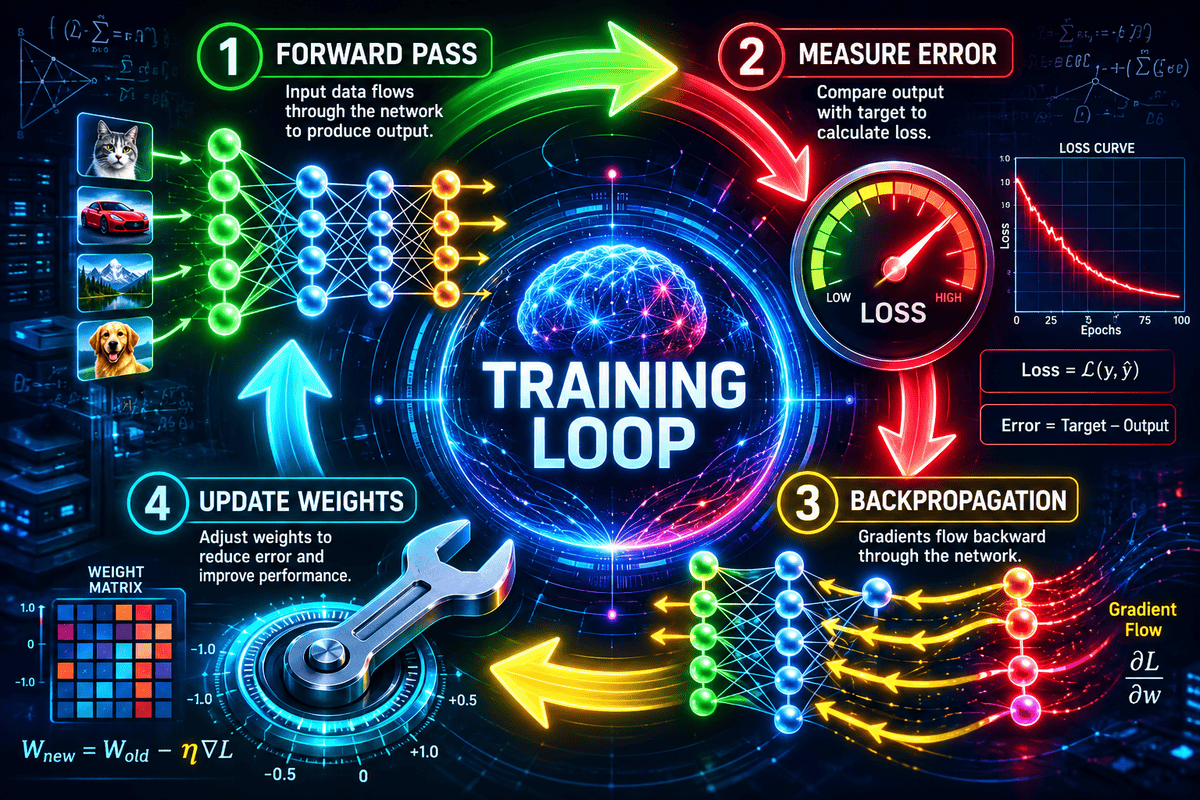
Step 1 – Forward Propagation (Making a Guess)
- Feed the input data into the input layer.
- Each neuron calculates its weighted sum and applies its activation function.
- The result passes to the next layer, which does the same.
- This continues until the output layer produces a prediction.
That full pass from input to output is called a forward pass or forward propagation.
Step 2 – Loss (Measuring How Wrong the Guess Was)
The network’s prediction gets compared to the correct answer. The difference is called the loss (sometimes called the error or cost). A high loss means the network was very wrong. A loss near zero means it was close.
Common loss functions include mean squared error (for number predictions) and cross-entropy loss (for classification). The exact formula matters less than the idea: loss is the score that tells the network how badly it needs to improve.
Step 3 – Backpropagation (Tracing the Mistake Backward)
Backpropagation is the method the network uses to figure out which weights caused the error. It works backward from the output layer to the input layer, calculating how much each weight contributed to the loss.
Think of it this way: if a team loses a game, backpropagation is the post-game review that figures out exactly which players made which mistakes – so each player knows what to fix.
The math behind this uses calculus (specifically the chain rule), but you don’t need to know that to understand what it does. It just answers: “How much should this weight change?”
Step 4 – Gradient Descent (Fixing the Mistake)
Once backpropagation identifies how much each weight contributed to the error, gradient descent updates every weight using this rule:
w ← w − η × (∂L/∂w)
In plain words:
- w = the current weight
- η (eta) = the learning rate – the step size, like how big a correction to make each time (too large and the network overshoots; too small and it learns painfully slowly)
- ∂L/∂w = how much this weight affected the loss (calculated by backpropagation)
The network makes this tiny correction to every single weight, then runs the whole process again with the next batch of training data. Training a large modern model can mean adjusting billions of weights across millions of training examples.
What Are the Main Types of Neural Networks?
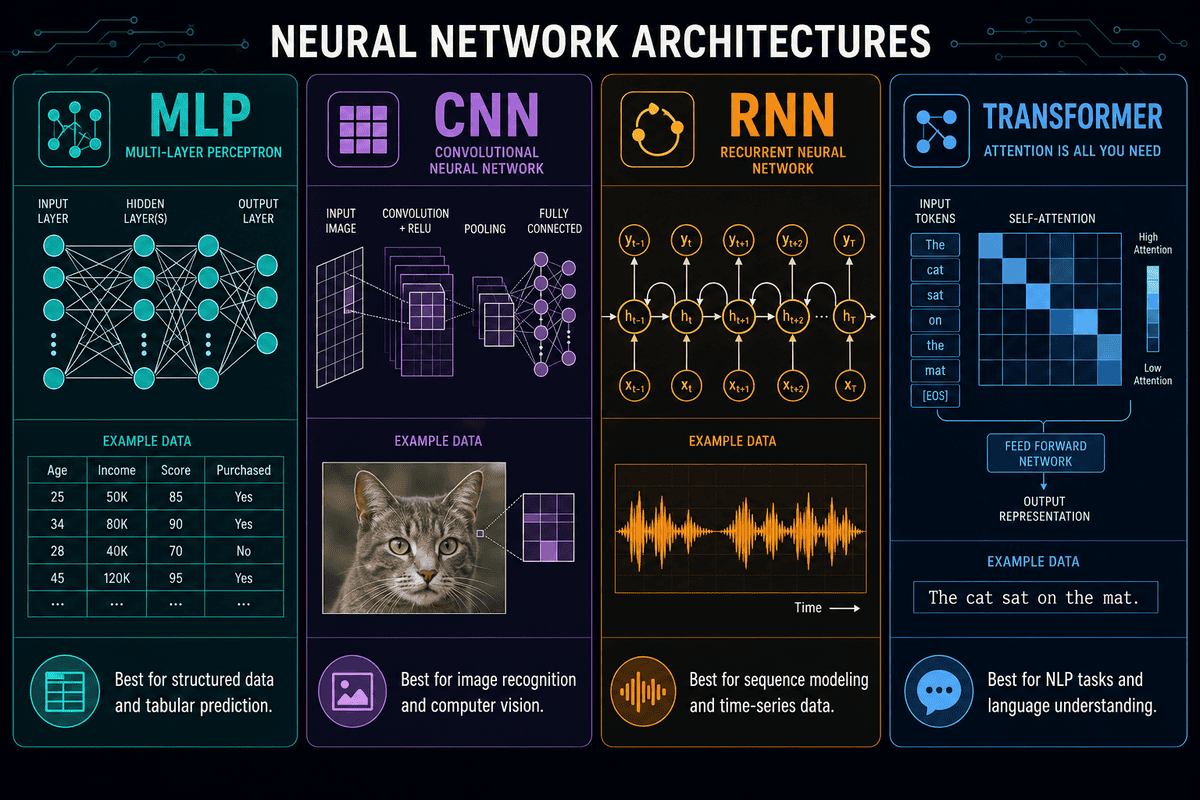
Different problems need different network designs. Images use CNNs, text uses transformers, tables use simple feedforward networks.
Here are the six main types:
- MLP (Multilayer Perceptron) / Feedforward network: The simplest type. Data flows in one direction, from input to output. Good for structured data like spreadsheets.
- CNN (Convolutional Neural Network): Designed for images. It scans the image in small patches (called convolutions), which lets it detect edges, shapes, and objects efficiently.
- RNN (Recurrent Neural Network): Designed for sequences. It has a “memory” that carries information from one step to the next – useful for time-series data or speech.
- LSTM (Long Short-Term Memory): A smarter version of RNN that remembers things over longer sequences without forgetting early context.
- Transformer: The current dominant architecture for language tasks. Instead of reading sequences one step at a time, it looks at all parts of the input at once using a mechanism called self-attention. Transformers are the backbone of large language models (LLMs) like ChatGPT.
- Autoencoder: Compresses data into a smaller representation, then reconstructs it. Used for denoising, anomaly detection, and data compression.
- GAN (Generative Adversarial Network): Two networks compete – one generates fake data, the other tries to spot fakes. Together, they learn to generate realistic images, audio, or video.
Type-Selection Decision Table
| If your data is… | Best network type | Used for |
|---|---|---|
| Images or video | CNN | Photo tagging, medical scans, self-driving vision |
| Text or sequences | Transformer (or RNN/LSTM) | Chatbots, translation, autocomplete |
| Tables or numbers | MLP / feedforward | Forecasting, fraud scoring, demand prediction |
| Generating new data | GAN | Synthetic images, deepfakes, data augmentation |
| Compressing data | Autoencoder | Denoising, anomaly detection, feature learning |
What Are Neural Networks Used For? (Use-Case Playbook)
Neural networks power everyday tools like spam filters, photo search, voice typing, demand forecasting, and chatbots.
Here are five concrete scenarios showing how a neural network gets applied to a real problem.
Scenario 1 – Email Spam Filter (MLP)
- Inputs: Word frequency features (how often words like “free,” “winner,” “click here” appear in an email)
- Output: Spam (1) or Not Spam (0)
- Training data: Thousands of labeled emails – humans marked each one as spam or not
- Network type: MLP, because the data is structured (a table of word counts), not an image or sequence
- KPI: Catch rate (what % of spam gets blocked) vs. false positive rate (what % of real emails get wrongly blocked)
- Why MLP fits: The relationship between word patterns and spam labels is complex but the data is flat and tabular – no spatial or sequential structure needed
Scenario 2 – Photo Tagging (CNN)
- Inputs: Raw pixel values from a photo (e.g., a 224×224 image = 150,528 numbers)
- Output: “Cat” or “Not a cat” (or a list of probabilities for many categories)
- Training data: Millions of labeled images (the ImageNet dataset, for example, has over 14 million images across 20,000 categories)
- Network type: CNN, because convolution lets the network scan for edges, textures, and shapes efficiently
- Why CNN fits: Pixels near each other are related – a CNN exploits that spatial structure, while an MLP would ignore it
The 2012 AlexNet model, built by Geoffrey Hinton’s team, won the ImageNet competition by a large margin using a CNN. That moment is widely credited with launching the modern deep-learning era.
Scenario 3 – Chatbot and Autocomplete (Transformer)
- Inputs: Text broken into tokens (roughly, word pieces) – for example, “The cat sat on the” becomes 5 tokens
- Output: The most likely next token (“mat,” “floor,” “roof,” etc.)
- Network type: Transformer
- Why transformers replaced RNNs for language: RNNs read text one word at a time and struggle to connect ideas far apart in a sentence. Transformers look at all tokens at once using self-attention, which lets them handle long documents and complex context much better.
- Connection to today: ChatGPT, Google Gemini, and similar tools are all large language models built on transformer architectures. If you want to go deeper on what makes these models tick, here is a full breakdown of what a large language model actually is. When you type a message and get a reply, a neural network is predicting the most likely next token, over and over, until the answer is complete.
Scenario 4 – Demand Forecasting (MLP on Tabular Data)
- Inputs: Past sales numbers, day of week, season, price, promotional events
- Output: Predicted demand for the next week
- Network type: MLP, because the data is a structured table
- KPI: Forecast error percentage (how far off the prediction is from actual demand)
- Why it works: The relationship between price, season, and demand is non-linear and complex – an MLP can learn these patterns from historical data without anyone writing explicit rules
Scenario 5 – Voice-to-Text (RNN/LSTM)
- Inputs: An audio sequence – the sound wave broken into small time slices
- Output: Words (the transcribed text)
- Network type: RNN or LSTM, because speech is a sequence where earlier sounds affect the meaning of later ones
- Why sequence models fit: The word “bank” means something different after “river” than after “money.” An LSTM can carry that earlier context forward to help decode the current sound.
Neural Networks vs. Deep Learning vs. Machine Learning
They are nested concepts – machine learning is the big circle, neural networks sit inside it, and deep learning is neural networks with many hidden layers.
Picture Russian nesting dolls. The outermost doll is artificial intelligence – the broad goal of making machines do intelligent things. Open it and you find machine learning – the approach of letting machines learn from data instead of following hand-written rules. Open that and you find neural networks – one specific type of machine-learning model. Open that and you find deep learning – neural networks that have many hidden layers, giving them the power to learn very complex patterns.
| Term | What it is | Example |
|---|---|---|
| Machine learning | Any model that learns patterns from data | Spam filter, decision tree, random forest |
| Neural network | One ML model type, built from layers of neurons | Image classifier, speech recognizer |
| Deep learning | A neural network with many hidden layers | ChatGPT, self-driving car vision, AlphaFold |
One-sentence definitions:
- Machine learning is the field of building models that improve from data.
- A neural network is a machine-learning model organized into layers of connected neurons.
- Deep learning is machine learning using neural networks deep enough to learn hierarchical patterns.
Do Neural Networks Really Work Like the Human Brain? (Myths)
No – the human brain is the inspiration, not the blueprint. Neural networks are math, not biology.
This is one of the most repeated misunderstandings in AI. Here are four specific myths worth correcting.
Myth 1: A neural network is basically a digital brain. False. A biological brain has roughly 86 billion neurons connected in ways science still doesn’t fully understand. They communicate with chemical signals, change physically over time, and run on about 20 watts of power. A neural network is a matrix multiplication running on a GPU. The word “neuron” is borrowed loosely – the actual mechanisms are completely different.
Myth 2: Artificial neurons work like biological neurons. They don’t. A biological neuron integrates thousands of signals across a complex dendritic tree and fires electrochemical pulses. An artificial neuron multiplies numbers, adds them up, and applies a math function. The resemblance is conceptual, not functional.
Myth 3: Backpropagation is how the brain learns. There is no strong evidence that the brain uses anything like backpropagation. The brain doesn’t have a clear “loss function” or a mechanism that sends error signals backward through layers the way backprop does. Researchers are still working to understand how biological learning actually works.
Myth 4: More layers always means a smarter network. Adding layers helps up to a point – but beyond that, it creates new problems (vanishing gradients, overfitting, longer training times). The right number of layers depends on the problem, the data size, and the compute available. Bigger is not always better.
What Are the Limitations of Neural Networks?
Neural networks are powerful, but they are also data-hungry, expensive to train, hard to interpret, and easy to break in subtle ways.
Here are the five main limitations every beginner should know.
1. Overfitting Overfitting happens when a network memorizes the training data instead of learning general patterns. It performs great on training examples but poorly on new data it hasn’t seen. The fix is more data, regularization techniques, or a simpler model – but it’s a constant challenge.
2. Data hunger Neural networks learn by example. A simple model might need thousands of labeled examples. A large image classifier might need millions. A large language model is trained on hundreds of billions of words. If you have a small dataset, a simpler model (like a decision tree or logistic regression) will often outperform a neural network.
3. The black-box problem The black-box problem It’s often very hard to explain why a neural network made a specific decision. A recent systematic review analyzing deep learning in high-stakes decisions, including healthcare and criminal justice, found that this lack of transparency can undermine trust and accountability. This tension shows up clearly in generative AI healthcare use cases, where accuracy alone isn’t enough if doctors can’t see the reasoning behind a recommendation. Researchers are actively building interpretability tools, but the problem isn’t fully solved.
4. Compute and GPU cost Training large neural networks requires significant computing power, usually in the form of GPUs (graphics processing units) or specialized chips. Training a large language model can cost tens of millions of dollars in cloud compute – for example, GPT-4 required an estimated $78 million in compute.
5. Vanishing gradients In very deep networks, the gradient signal used to update weights can get smaller and smaller as it travels backward through layers. By the time it reaches the early layers, the signal is nearly zero – so those layers barely learn. Techniques like ReLU activation, batch normalization, and residual connections (skip connections) help, but the problem still shows up in poorly designed architectures.
A quick history note: Neural networks were invented in the 1940s and 1950s (McCulloch and Pitts proposed the first mathematical neuron model in 1944; Frank Rosenblatt built the perceptron in 1958). But they were largely abandoned for decades because computers weren’t fast enough and data wasn’t available. The 2012 AlexNet breakthrough – which used GPUs and a large labeled dataset – showed the world what deep networks could do when given enough compute and data.
How to Start Learning Neural Networks (Stage-Based Roadmap)
The best path is staged: understand the concept first, then run a tiny model, then build something real.
Stage 1 – Curious Beginner
- Watch one visual explainer (3Blue1Brown’s “Neural Networks” series on YouTube is widely recommended for beginners)
- Understand the single-neuron formula: z = Σ(wᵢxᵢ) + b, then a = f(z)
- Learn the vocabulary: neuron, weight, bias, layer, activation function, forward pass, backpropagation
- Read about the history: Rosenblatt’s perceptron (1958), the 2012 AlexNet moment
Stage 2 – Hobbyist
- Install Python and run a tiny model in a notebook using Keras or PyTorch
- Try the MNIST dataset – it’s a collection of 70,000 handwritten digit images, and it’s the friendliest first project in machine learning
- Experiment with changing the number of layers and neurons and see what happens to accuracy
- Learn what a training loop looks like in code (forward pass → loss → backward pass → weight update)
Stage 3 – Builder
- Learn backpropagation properly – understand why the chain rule connects the loss to each weight
- Build a small CNN and train it on an image dataset
- Study one real project end-to-end: data loading, preprocessing, training, evaluation, and deployment
- Explore TensorFlow, PyTorch, and Keras documentation – these are the three dominant frameworks in 2026
Mini Workbook – “Could a Neural Network Solve My Problem?”
Before building anything, run through this six-step checklist:
- Do I have a clear input and a clear desired output? (e.g., “email text in, spam/not-spam out”)
- Do I have enough labeled examples? (hundreds for simple problems, millions for complex ones – be honest about what you have)
- Is the pattern too complex for simple rules? (if you could write the rules by hand, you might not need a neural network)
- Can I tolerate a “black-box” answer? (in medicine or law, you may need to explain every decision – neural networks make that hard)
- Do I have compute to train? (a laptop works for small models; large models need cloud GPUs)
- Is a simpler model actually enough? (logistic regression, random forests, and gradient boosting often outperform neural networks on small tabular datasets – try them first)
Common Mistakes Beginners Make About Neural Networks
These five mistakes come up constantly. Knowing them in advance saves a lot of frustration.
- Thinking “more layers = smarter.” More layers help with complex problems but hurt on simple ones. Always start with the simplest architecture that could work.
- Believing the network “thinks” like a human. It doesn’t think. It multiplies numbers. The outputs can look intelligent, but the process is arithmetic.
- Ignoring data quality. A neural network trained on bad, biased, or mislabeled data will produce bad, biased outputs – reliably. Garbage in, garbage out.
- Skipping activation-function intuition. Many beginners copy-paste ReLU everywhere without understanding why. Knowing what each activation function does helps when something breaks.
- Expecting it to work with tiny datasets. If you have 200 examples, a neural network will almost certainly overfit. Try a simpler model first.
Frequently Asked Questions
Do artificial neural networks actually work like the human brain?
No, artificial neural networks do not actually work like the human brain. While loosely inspired by biological neurons, they are highly simplified mathematical models. The human brain uses complex, energy-efficient chemical and electrical processes to learn continuously, whereas AI relies on rigid mathematical algorithms and statistics that have no biological equivalent.
Is ChatGPT a neural network?
Yes, ChatGPT is a neural network. Specifically, it is built upon a deep learning framework known as the Transformer architecture. As a large language model (LLM), this artificial neural network processes massive datasets to recognize complex language patterns, understand context, and generate highly accurate, human-like text responses.
Is a neural network the same as AI?
No. AI is the broad goal of making machines perform intelligent tasks. A neural network is one specific technique used to achieve that goal. AI also includes rule-based systems, search algorithms, and many other approaches.
How hard is it to learn neural networks, and what are the best beginner resources?
Learning neural networks is challenging but highly accessible. While mastering the underlying calculus and linear algebra takes time, modern Python frameworks like PyTorch and TensorFlow simplify the process. Most beginners can grasp the fundamentals in three to four months.
The best beginner resources include:
- Coursera: Andrew Ng’s Deep Learning Specialization (best for theory)
- Fast.ai: Practical Deep Learning for Coders (best for hands-on coding)
- YouTube: 3Blue1Brown’s visual neural network series (best for concepts)
- Kaggle: Free datasets and community tutorials (best for practice)
What is the difference between AI and neural?
Artificial Intelligence (AI) is the broad concept of creating machines capable of mimicking human intelligence. A neural network is a specific, highly advanced technique within AI. While AI includes simple rule-based systems, neural networks use interconnected nodes to independently learn complex patterns from massive datasets.
Do neural networks work like the human brain?
They are loosely inspired by the brain, but they are not brains. Artificial neurons multiply numbers and apply math functions. Biological neurons fire electrochemical signals through a structure science still doesn’t fully understand.
Are neural networks inherently bad?
No, neural networks are not inherently bad. They are neutral mathematical tools designed to process data and recognize patterns. Like any technology, their moral impact depends entirely on human application. However, if trained on flawed datasets or misused, they can amplify human biases, generate misinformation, or create opaque decision-making models.
How many layers does a neural network need?
At minimum, three: an input layer, at least one hidden layer, and an output layer. “Deep” learning refers to networks with more than one hidden layer. There is no single right number – it depends on the complexity of the problem.
What is the difference between a neural network and deep learning?
Deep learning is a neural network with many hidden layers. All deep learning models are neural networks, but not all neural networks are deep learning models.
Can neural networks learn without labeled data?
Yes, some can. Autoencoders and certain self-supervised models learn from unlabeled data. But most common neural networks – classifiers, detectors, translators – require labeled training examples.
Why do neural networks need so much data?
They learn entirely by example. With more examples, the network sees more variation and learns more reliable patterns. With too few examples, it memorizes the training data instead of generalizing.
What is an activation function in simple terms?
A small math rule applied inside each neuron that lets the network learn curved, complex patterns instead of just straight lines. Without it, stacking layers would have no benefit.
What is backpropagation?
The method a network uses to trace its prediction error backward through every layer and calculate how much each weight contributed to the mistake – so each weight can be nudged toward a better value.
Are neural networks and ChatGPT the same thing?
ChatGPT is built on a neural network type called a transformer. So ChatGPT is a neural network, but neural networks are a much broader category that includes image classifiers, spam filters, voice recognition, and much more.
Is every AI a neural network?
No, not every AI is a neural network. Artificial Intelligence (AI) is the broad umbrella term for any machine designed to perform tasks that usually require human intelligence. A neural network is just one specific, highly effective technique used to achieve AI.
How long does training take?
Anywhere from a few seconds for a tiny model on a laptop to several weeks for a large language model running on thousands of GPUs. A beginner model on MNIST typically trains in under five minutes on a modern laptop.
Why are neural networks called “black boxes”?
Because it is hard to look inside a trained network and understand exactly why it made a specific decision. The weights encode patterns, but those patterns aren’t human-readable. Researchers are building interpretability tools to address this, but it remains an active challenge.
Can I build a neural network without advanced math?
Yes. Tools like Keras and PyTorch let you build a working model with basic Python coding skills and a conceptual understanding of the ideas. Advanced math helps when you need to debug or design novel architectures, but it’s not required to get started.
Conclusion
A neural network is layers of simple units that learn patterns by adjusting weights – and now you’ve seen one do the actual math, step by step.
The words that sounded scary at the start – backpropagation, activation function, gradient descent – are just names for simple ideas: trace the mistake backward, add a bend so the network can learn curves, take small correction steps. None of it requires a math degree to understand at a working level.
The field is moving fast. As of 2026, transformers are reshaping what neural networks can do with language and vision. Researchers are working on making networks more predictable and interpretable. Regulatory frameworks like the EU AI Act are starting to shape how high-risk neural network applications get deployed. And tools like Keras and PyTorch have made it genuinely accessible for beginners to build and run their first model.
If you want to go one step further, try running a tiny model on the MNIST handwritten-digits dataset. It trains quickly, the data is free, and watching a network learn to recognize handwriting in real time makes every concept in this guide click into place.

Shivakumar K Naik is an SEO Analyst and Technology Writer based in Mysore, Karnataka with 2.5+ years of experience and 28+ client success stories across FinTech, Travel, Automotive, SaaS and Education. He has delivered 150+ Google first-page rankings for brands like Mudrex, Decathlon and Maruti Suzuki. On Tech Caffeine, he writes practical, beginner-friendly guides on AI tools, how to make money online with AI, cryptocurrency, blockchain, NFTs, gaming and emerging technology content built from real SEO experience and daily hands-on use of ChatGPT, Claude, Ahrefs and Semrush.