
Last updated: March 16, 2026
Quick Answer
Yes, AI agents can make outbound calls, and many businesses already use them for reminders, lead qualification, surveys, collections follow-ups, and routine sales outreach. The bigger question is not whether AI voice agents can call, but when they are legally allowed, where they work well, and when a human should take over.
Key Takeaways
- AI agents can make outbound calls using text-to-speech, speech recognition, and call automation platforms.
- Outbound AI calling works best for structured conversations like appointment reminders, qualification, confirmations, and simple follow-ups.
- In the U.S., AI-generated voices are treated as artificial or prerecorded voices under TCPA rules, so many telemarketing uses require prior express written consent.
- Trust is a major issue because unwanted and fake calls are rising. Hiya reported that 1 in 4 Americans received an AI deepfake voice call in the past year.
- Choose AI calling when the script is clear, the risk is low, and escalation to a human is easy.
- Choose human agents for complex objections, sensitive cases, and regulated conversations.
- Strong outbound programs need disclosure, consent tracking, opt-out handling, call recording policies, and fraud controls.
- New speech models are getting faster and cheaper, including low-latency local voice processing options that may improve privacy.
- A pilot campaign should start small, measure complaint risk, and include human review of failed calls.
- In 2026, the safest approach is AI for routine outreach, humans for judgment-heavy conversations.
What does “AI outbound calling” actually mean?
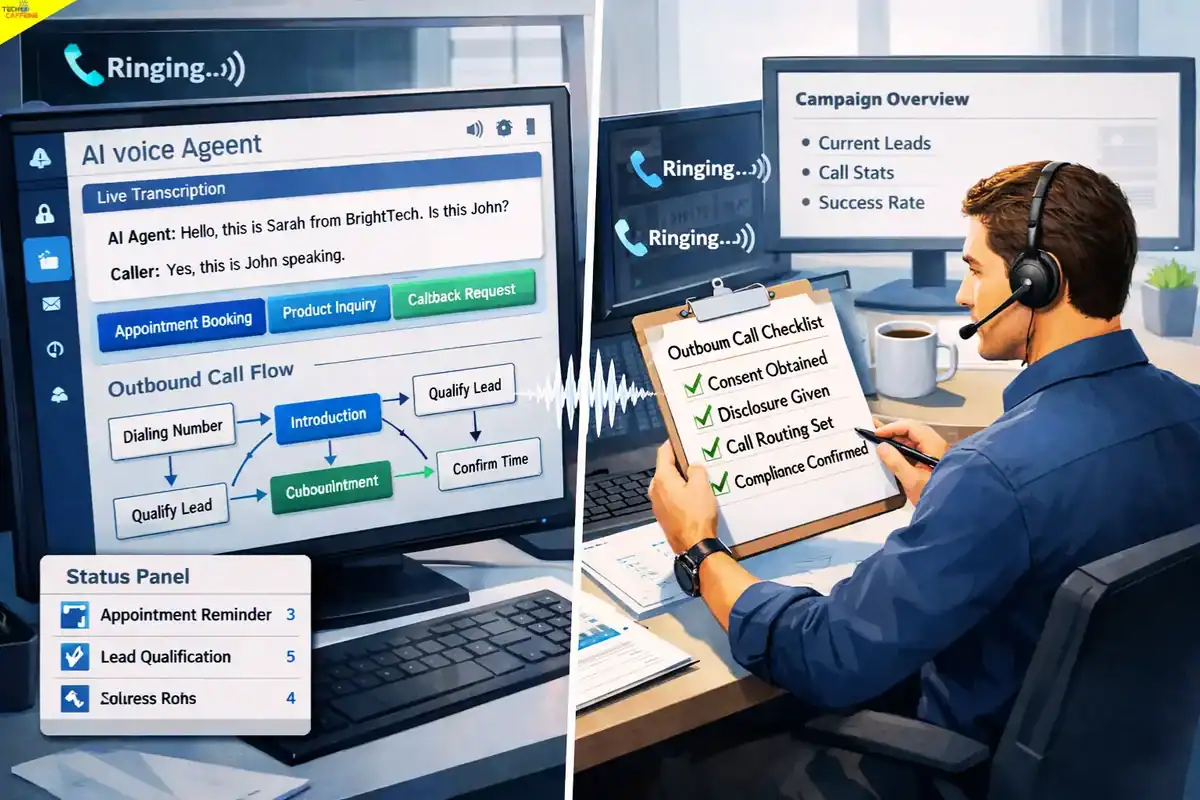
AI outbound calling means software places a phone call and uses voice AI to speak, listen, and respond in real time. A basic robocall plays a fixed recording, but a modern AI voice agent can handle short back-and-forth conversation, update a CRM, and transfer the caller to a human when needed.
In practice, there are a few different versions:
- Simple automated calls: prerecorded reminders or alerts
- Interactive AI calls: the system understands answers and replies dynamically
- Agent-assist outbound: AI starts the call, gathers details, then hands off to a person
- Hybrid workflows: AI qualifies the lead, books time, and sends notes to sales
A common real-world example is a dental office reminder call. The AI agent says the patient’s name, confirms the appointment time, answers “Can I reschedule?”, then routes the call if the request becomes complicated.
AI outbound calling is most useful when the business needs consistency, speed, and clear next steps, not deep persuasion.
For readers new to the broader field, Tech Caffeine also has a useful introduction to what a large language model is and more tools in its artificial intelligence section.
Can AI agents make outbound calls legally?
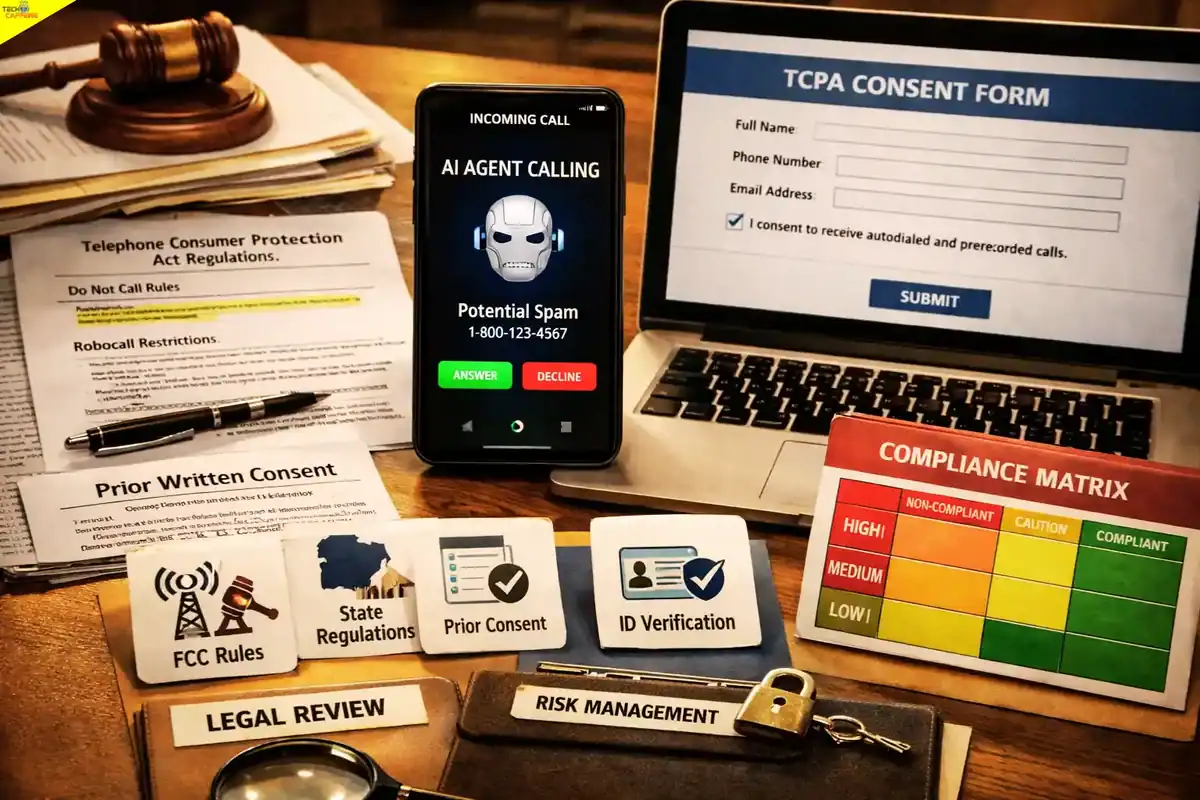
Yes, AI agents can make outbound calls legally, but legality depends on consent, call purpose, location, and disclosure. In the U.S., the FCC clarified that AI-generated voices count as an “artificial or prerecorded voice” under the TCPA, which means consumer telemarketing calls often require prior express written consent.
That legal detail changes everything.
What matters most for compliance
- Telemarketing vs informational calls: sales calls face stricter rules than reminders or service notices
- Consumer vs business numbers: B2C campaigns usually carry more risk than B2B outreach
- Consent records: the business should be able to prove who consented, when, and for what purpose
- State rules: state privacy and AI laws may add new requirements beyond federal rules
- Opt-out handling: every call flow should include a fast, working do-not-call path
The compliance pressure is growing. Speechmatics noted that voice AI compliance has become a board-level concern, not a simple procurement box to tick. Colorado’s AI Act taking effect in June 2026 adds another layer of state-level scrutiny for some organizations.
Common mistake
A common mistake is assuming, “The call is conversational, so it’s not a robocall.” That is risky. If the voice is AI-generated, the FCC’s position matters more than how natural the call sounds.
Quick rule
- Choose AI outbound calling if the business has documented consent, a narrow use case, and legal review.
- Choose manual calling if consent is unclear or the campaign involves sensitive persuasion.
For businesses building internal policy, Tech Caffeine’s pages on privacy policy and terms and conditions are also relevant reference points.
Can AI agents make outbound calls for sales, support, and reminders?
Yes, AI agents can make outbound calls for sales, customer support, reminders, collections, and reactivation campaigns. The best results come from predictable call paths where the AI only needs to gather specific answers and trigger clear next steps.
AI outbound calling — use cases
- Appointment reminders
- Delivery notifications
- Payment reminders
- Lead qualification
- Event confirmations
- Post-demo follow-up
- Simple win-back campaigns
- Customer satisfaction surveys
- High-stakes medical conversations
- Complex financial advice
- Escalated complaints
- Negotiations with legal or compliance risk
- Calls where empathy and trust matter more than speed
One B2B example helps here. A software company with hundreds of webinar signups may use AI to call registrants, confirm interest, ask one qualifying question, and book meetings. That approach matches buyer behavior better than a hard-sell script. Trellus cites Gartner data that 61% of B2B buyers prefer a rep-free buying experience, which makes low-pressure, helpful outbound automation more relevant in some B2B contexts.
Edge case
An AI call can work for a healthcare reminder, but once the conversation touches symptoms, treatment concerns, or billing disputes, a human agent should take over. The use case is the difference.
Can AI agents make outbound calls better than humans?
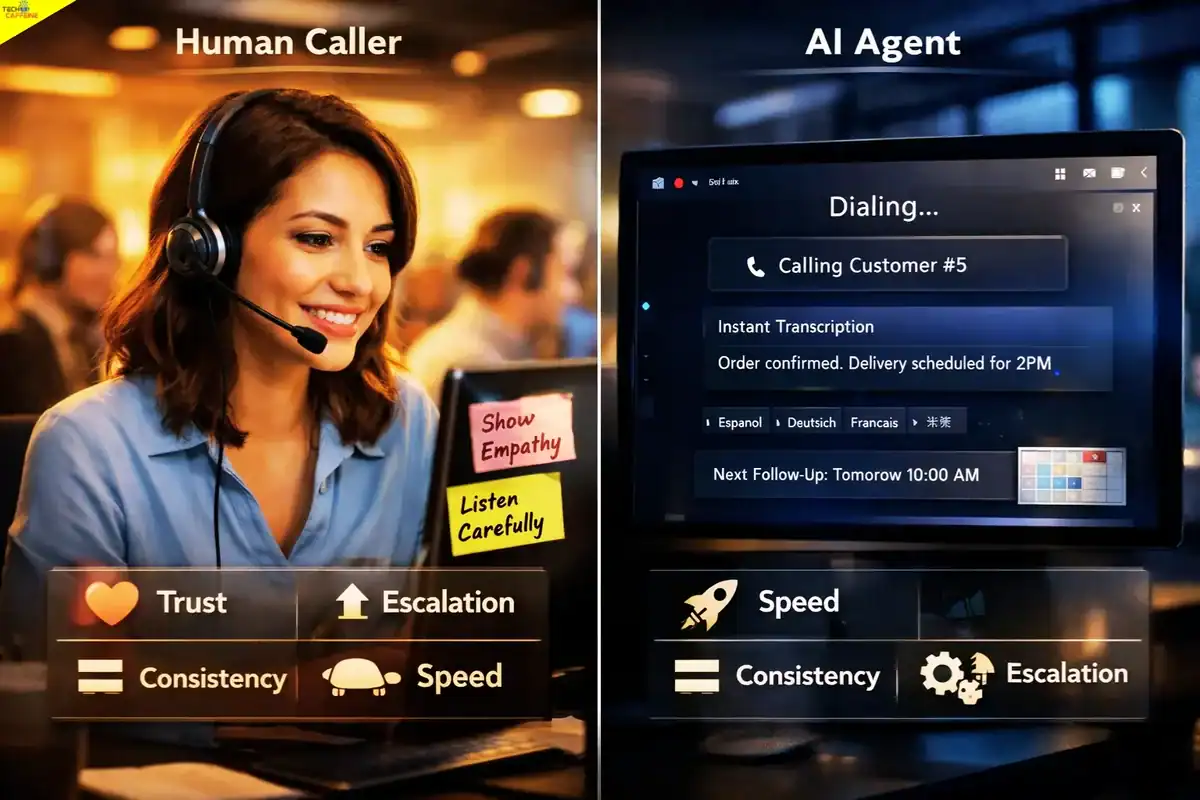
Sometimes, yes, but only for narrow jobs. AI agents are usually better at speed, consistency, and cost control, while human agents are better at judgment, empathy, and handling messy conversations.
AI vs human outbound calling
| Factor | AI agents | Human agents |
|---|---|---|
| Call volume | ✓ Excellent for high volume | Limited by staffing |
| Script consistency | ✓ Very high | Varies by rep |
| Cost per routine call | ✓ Often lower at scale | Usually higher |
| Complex objections | Weak to moderate | ✓ Strong |
| Emotional nuance | Limited | ✓ Strong |
| Availability | 24/7 possible | Shift-based |
| Compliance risk | High if poorly configured | High if poorly trained |
| Escalation handling | Needs workflow design | ✓ More flexible |
A small service business often learns this the hard way. The owner launches AI outreach for overdue invoices and sees good callback rates, but angry customers feel dismissed when the bot repeats itself. After changing the flow so AI handles only the first reminder and humans handle disputes, the campaign improves.
Choose X if…
- Choose AI if the call can be mapped into 5 to 10 predictable intents.
- Choose a human if the call requires persuasion, negotiation, or emotional care.
- Choose hybrid if AI can gather facts first, then transfer context to a rep.
AssemblyAI and Deepgram both frame voice agents as systems that combine speech recognition, language understanding, and action-taking, but that does not mean every conversation should be automated.
What are the biggest risks of AI outbound calling in 2026?
The biggest risks are legal violations, scam confusion, low trust, and poor escalation. In 2026, an AI outbound program can fail even when the technology works, because customers may assume the call is fake or manipulative.
Hiya reported that 1 in 4 Americans received an AI deepfake voice call in the past year, and consumers received an average of 9.9 unwanted calls per week. That matters because trust affects answer rates, call duration, and complaints.
Main risks to watch
- TCPA violations from missing or invalid consent
- Brand damage if customers feel tricked
- Deepfake confusion when the voice sounds too polished or too familiar
- Poor authentication that makes real calls look suspicious
- Weak fallback logic when the AI misunderstands a response
- Voice-based fraud if the system relies too heavily on voice identity alone
Hiya’s CEO argued that telecom systems need AI-based caller authentication before the phone even rings. That aligns with a wider shift toward stronger verification and fraud prevention.
Common mistake
A common mistake is trying to clone a founder’s or executive’s voice for outreach. Even if technically possible, that creates serious legal and reputation risk, especially as proposed legislation around synthesized likeness gains attention.
Better approach
Use a clearly artificial but professional voice, disclose that the caller is an AI assistant, and provide a human callback option early in the call.
For readers exploring practical AI tools beyond voice, these guides may help: best AI personal assistants, best AI calendar apps, and best AI resume builders.
How do businesses set up outbound AI calling the right way?
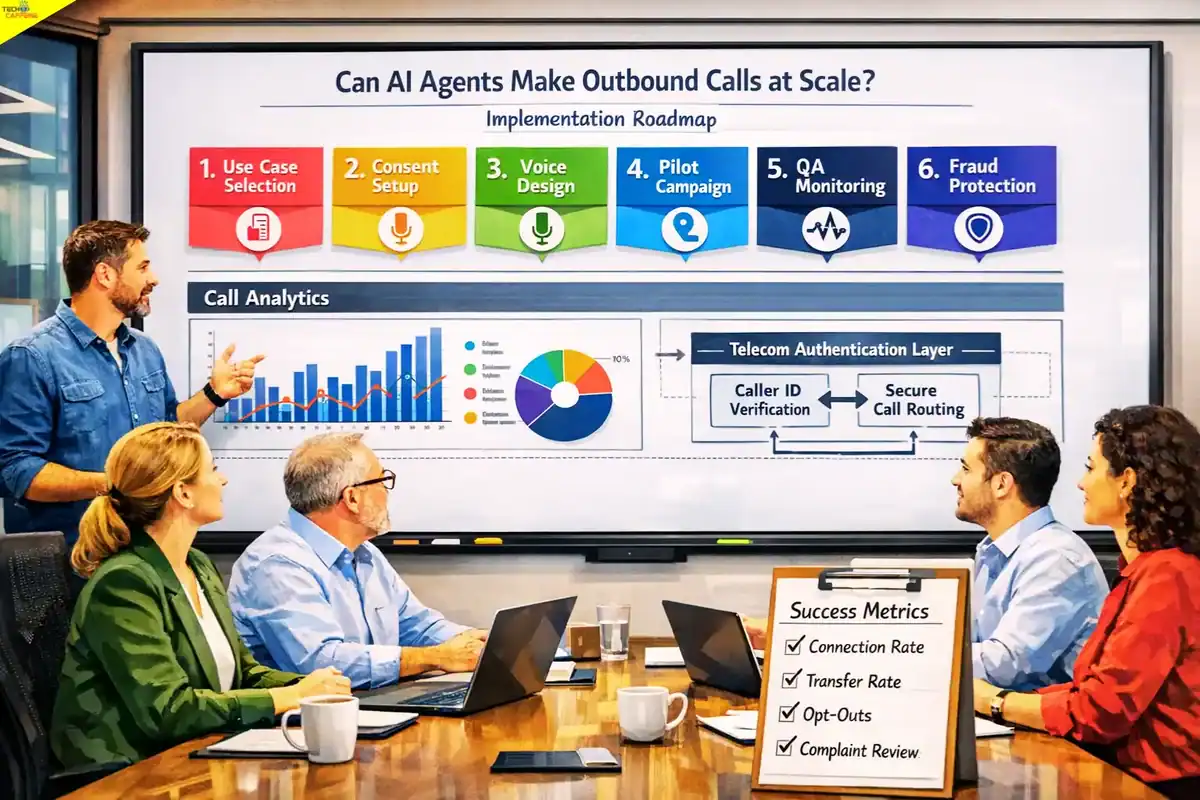
Businesses should start with one low-risk use case, connect it to a consented contact list, build a short call flow, and review every failure before scaling. A careful rollout beats a flashy launch every time.
Step-by-step checklist
- Start with reminders, qualification, or confirmations
- Avoid high-risk sectors first
- Confirm who can be called
- Save proof of consent
- Add opt-out language
- Opening disclosure
- 3 to 5 likely intents
- Human transfer point
- Voicemail path
- CRM
- Calendar
- Dialer
- Ticketing or help desk
- Review transcripts
- Track transfers
- Check complaints and opt-outs
- Caller ID consistency
- Verification steps
- Human callback option
- Expand volume slowly
- Re-test scripts
- Audit compliance monthly
Mini example
A local auto service chain used AI to confirm next-day appointments. The first version tried to answer every question and frustrated callers. The second version only handled confirmation, cancellation, and “talk to staff.” That simpler design worked better because the goal was narrower.
Mistral’s 2026 release of low-latency speech models also points to a practical change: some voice processing can run locally on laptops or phones, which may reduce cost and improve privacy in certain setups.
How much does AI outbound calling cost and when is it worth it?
AI outbound calling can be cost-effective for repetitive, high-volume calls, but the total cost depends on software, telephony, integration work, compliance review, and human oversight. It is worth it when the business handles enough routine calls to justify setup and quality control.
Because pricing varies by provider, a safer buying rule is:
- Worth it if the business already has high call volume, clear call scripts, and measurable outcomes
- Not worth it if call volume is low or every call needs custom human judgment
Cost drivers
- Minutes used
- Voice model quality
- CRM and dialer integration
- Local vs cloud deployment
- Compliance and legal review
- Human QA staff
- Transfer handling and support coverage
Edge case
Highly regulated industries may prefer on-premises or tightly controlled deployments because security and audit needs can outweigh convenience. In those cases, the cheapest option is not always the best one.
Can AI agents make outbound calls in a way customers will accept?
Yes, but customer acceptance depends on trust, clarity, and restraint. People are more likely to accept AI outbound calls when the purpose is helpful, the identity is clear, and a human is easy to reach.
What improves acceptance
- State the purpose in the first sentence
- Identify the caller as an AI assistant
- Use a natural but not deceptive voice
- Keep the call short
- Offer a keypad or verbal opt-out
- Transfer quickly when requested
- Call at reasonable times
- Follow up by text or email when appropriate
What reduces acceptance
- Pretending the caller is human
- Long, rambling scripts
- Repeating misunderstood answers
- Cold sales outreach without clear consent
- Spoofed or inconsistent caller ID
A helpful test is simple: if a business would be uncomfortable posting the script publicly, the script probably should not be used.
FAQ
Can AI agents make outbound calls on their own?
Yes. AI voice systems can dial numbers, speak, listen, and route outcomes automatically when connected to telephony and workflow tools.
Are AI outbound calls legal in the U.S.?
They can be legal, but many telemarketing uses require prior express written consent because AI-generated voices are treated as artificial or prerecorded voices under TCPA rules.
Can AI agents make outbound calls for cold calling?
They can, but cold calling with AI is legally and reputationally risky, especially in consumer telemarketing without clear consent.
Do AI voice agents sound human now?
Many sound very natural, but sounding human does not remove compliance duties or customer trust concerns.
Are AI outbound calls better for B2B or B2C?
AI outbound calls are often easier to justify in structured B2B use cases, while B2C campaigns face stricter consent and trust issues.
Can AI agents leave voicemails?
Yes. Many systems can detect voicemail and leave a preset or dynamic message.
Should businesses disclose that the caller is AI?
Yes. Clear disclosure lowers trust risk and supports a cleaner customer experience.
Can AI agents make outbound calls in healthcare or finance?
Yes, but those sectors need tighter controls, narrower use cases, and stronger legal review.
What is the safest first use case?
Appointment reminders or confirmation calls are usually safer than direct sales outreach.
How should a business start testing AI outbound calls?
Start with one low-risk workflow, a consented list, a small pilot group, and human review of every failed call.
Conclusion
So, can AI agents make outbound calls? Yes, and in 2026 they can do it well for the right tasks. But success depends less on the voice model and more on consent, clear use cases, trust, escalation design, and compliance discipline.
The best next step is simple:
- Pick one routine outbound workflow.
- Confirm legal requirements and consent.
- Build a short script with disclosure.
- Add a human handoff.
- Pilot small, review transcripts, then scale carefully.
AI outbound calling is not a replacement for every phone conversation. It is a tool for the calls that are repetitive, structured, and time-sensitive. Use it there, and it can save teams hours while giving customers faster answers. Use it everywhere, and it can create legal and brand problems just as fast.

Shivakumar K Naik is an SEO Analyst and Technology Writer based in Mysore, Karnataka with 2.5+ years of experience and 28+ client success stories across FinTech, Travel, Automotive, SaaS and Education. He has delivered 150+ Google first-page rankings for brands like Mudrex, Decathlon and Maruti Suzuki. On Tech Caffeine, he writes practical, beginner-friendly guides on AI tools, how to make money online with AI, cryptocurrency, blockchain, NFTs, gaming and emerging technology content built from real SEO experience and daily hands-on use of ChatGPT, Claude, Ahrefs and Semrush.