
Last Updated: May 12, 2026
Quick Answer: Building an AI agent in 2026 costs between $8,000 and $400,000+ depending on complexity, integrations, and autonomy level. A simple proof-of-concept runs $8,000–$35,000. A full workflow automation agent costs $35,000–$120,000. A multi-agent enterprise system can exceed $400,000. Monthly operating costs (OpEx) add $1,500–$20,000+ depending on usage volume and model choice.
Key Takeaways
- PoC/MVP agents cost $8,000–$35,000 and take 4–10 weeks to build.
- Workflow agents cost $35,000–$120,000 and take 8–20 weeks.
- Multi-agent systems cost $100,000–$400,000+ and take 20–40+ weeks.
- Monthly LLM API costs range from $50/month (low volume) to $20,000+/month (high volume).
- Autonomous agents trigger 3–10 internal LLM calls per user request – making them 6–8x more expensive to run than simple chatbots on GPT-4 API.
- GPT-4 API monthly costs by autonomy level: $150–$600 (assisted), $1,200–$5,500 (semi-autonomous), $4,000–$22,000+ (fully autonomous) at typical task volumes.
- Retry and error-recovery loops add 10–15% to your token bill — a tool call failure rate of 10–15% is normal and must be budgeted for.
- When monthly GPT-4 API costs exceed $5,000, routing simple queries to GPT-4o-mini or self-hosting Llama 3 can cut per-task costs by 5–10x.
- India-based teams cost 40–60% less than US/EU teams for equivalent work.
- Hidden costs – compliance, logging, human-in-the-loop design — routinely add 20–35% to budgets.
- Open-source models like Llama 3 can cut per-token costs by 3–10x at scale vs. GPT-4o.
- Analyst and survey data suggest that around 40% of companies plan to deploy AI agents within 12 months, and over 40% of projects are projected to fail or be cancelled by 2027 due to cost overruns and security gaps.
- Always budget a 15–20% contingency on top of your build estimate.
- Platform agents (Intercom Fin, Zendesk AI) are faster to deploy but become expensive above $3,000–$5,000/month in usage.
What Is an AI Agent in 2026?
An AI agent is software that can plan, decide, and act across multiple steps to complete a goal without a human directing every move. It’s different from a chatbot, which just responds to messages. It’s different from a Zapier workflow, which follows a fixed script. An AI agent can reason, use tools, remember context, and handle situations it wasn’t explicitly programmed for.
In 2026, agents use reasoning models (like GPT-4o and Claude Sonnet), agentic RAG pipelines, and multi-step planning to operate across real business systems.
Chatbot vs Automation Tool vs AI Agent vs Multi-Agent System
Not all AI systems are equal — here’s how Chatbots, Automation Tools, AI Agents, and Multi-Agent Systems differ across the five dimensions that matter most.
Feature |
Type 01
Chatbot
Conversational interface |
Type 02
Automation Tool
Zapier / Make |
Type 03
AI Agent
Autonomous reasoning system |
Type 04
Multi-Agent System
Collaborative agent network |
|---|---|---|---|---|
| Decision-making | None | Rule-based | Reasoning-based | Collaborative reasoning |
| Memory & Context | None or session-only | None | Short + long-term | Shared memory across agents |
| Tool Use | None | Predefined triggers | Dynamic tool calls | Orchestrated tool use |
| Autonomy Level | Zero | Low | Medium – High | High |
| Typical Use Case | FAQ responses | Data sync, notifications | Workflow automation, research | Complex multi-step enterprise processes |
Comparison based on general architectural capabilities · Individual implementations may vary · AI Agent and Multi-Agent categories reflect current LLM-based systems
How Much Does It Cost to Build an AI Agent in 2026? Cost Tiers at a Glance
Here is a direct answer: the cost depends almost entirely on three things – how complex the workflow is, how many systems it connects to, and how much it can do on its own.
Below is a summary table, followed by detail on each tier. All figures are typical ranges based on 2026 agency and vendor case studies, not fixed quotes.
AI Agent Development Cost by Tier: PoC, Workflow Agent & Multi-Agent System
AI agent projects don’t follow a one-size-fits-all budget — here’s how cost, timeline, and scope scale across the three main investment tiers.
Tier |
Column 1
Typical Cost
Estimated investment range |
Column 2
Timeline
Weeks from kickoff to delivery |
Column 3
Best For
Ideal project scenario |
|---|---|---|---|
| PoC / MVP Agent Proof of Concept | $8,000 – $35,000 | 4 – 10 weeks | Validating one business hypothesis |
| Workflow / Process Agent Production-ready automation | $35,000 – $120,000 | 8 – 20 weeks | Replacing or augmenting a defined process |
| Multi-Agent / Agentic System Enterprise-scale deployment | $100,000 – $400,000+ | 20 – 40+ weeks | Enterprise-grade transformation |
Cost ranges are estimates based on typical market rates · Actual figures vary by region, team size, and complexity · Timelines assume dedicated development resources
✅Tier 1: PoC / MVP Agent ($8,000–$35,000)
This is a single-workflow agent with 1–2 integrations and limited memory. It operates in “assisted” mode – a human confirms key actions. It’s built to answer one question: does this idea work?
What pushes costs to the upper end:
- More than 2 integrations
- Any real-time data requirements
- A polished UI instead of an internal admin panel
- Senior engineers instead of mid-level
✅Tier 2: Workflow / Business Process Agent ($35,000–$120,000)
This agent handles multiple workflows, connects to 3–6 systems, and uses a RAG/memory architecture. It operates semi-autonomously – it acts on most things but routes exceptions to humans.
What pushes costs to the upper end:
- Legacy system integrations (ERP, banking APIs)
- Complex exception-handling logic
- Compliance requirements (HIPAA, SOC 2)
- Custom UI for end users
✅Tier 3: Multi-Agent / Agentic System ($100,000–$400,000+)
Multiple coordinated agents, enterprise integrations, a governance layer, and full autonomy with human-in-the-loop checkpoints. This is a genuine transformation initiative, not a project.
What pushes costs to the upper end:
- Regulated industry requirements
- Custom orchestration layer (LangGraph, AutoGen)
- Multiple agent roles (planner, executor, reviewer)
- 24/7 uptime and SLA requirements
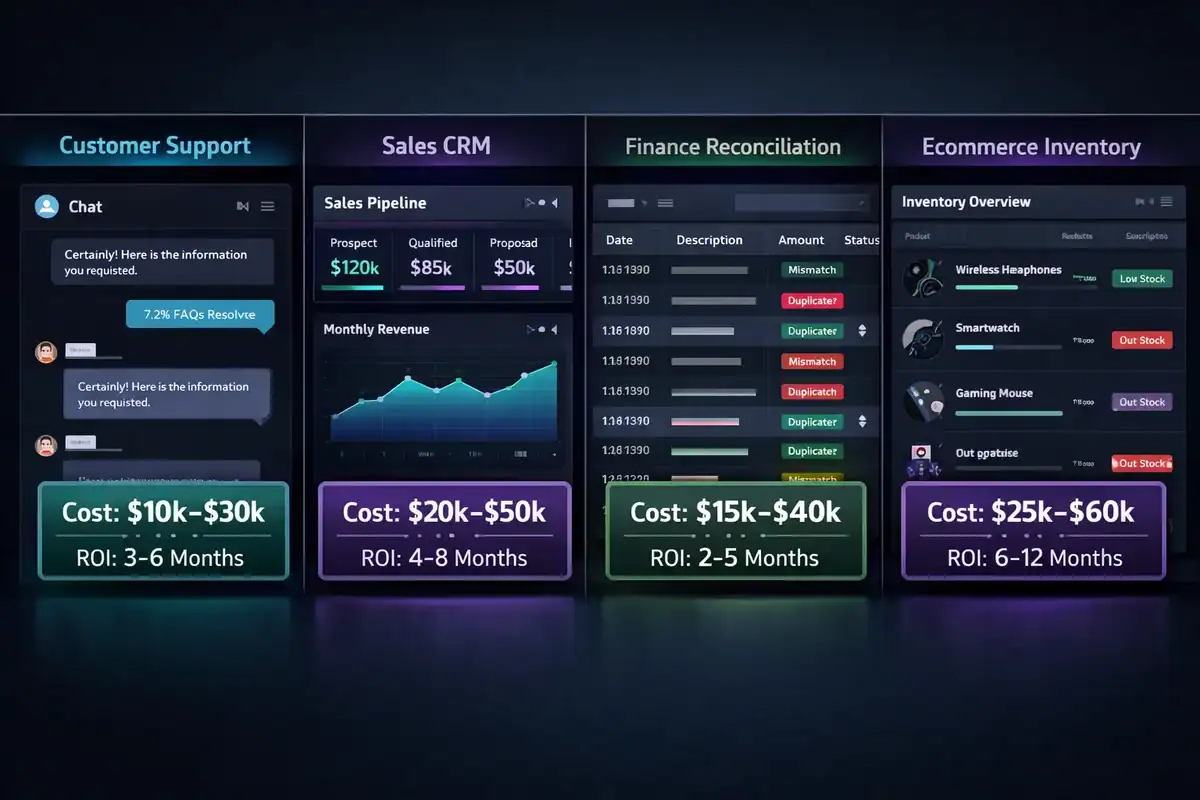
Use-Case Playbook: 4 Worked Budget Examples
No competitor gives you line-item budgets for real use cases. Here are four, based on actual project scoping patterns.
✅Example 1: Customer Support Deflection Agent
What it does: Handles tier-1 support queries, routes complex issues to humans, and integrates with your helpdesk, knowledge base, and CRM.
Key integrations: Zendesk or Intercom API, internal knowledge base (RAG), CRM (HubSpot/Salesforce), escalation workflow.
Cost Item |
Estimate
Typical Cost Range
USD · based on market averages |
|---|---|
| Agent Design & Architecture | $5,000 – $12,000 |
| LLM Integration & Prompt Engineering | $4,000 – $10,000 |
| RAG Pipeline (Knowledge Base) | $6,000 – $15,000 |
| Helpdesk + CRM Integrations | $8,000 – $18,000 |
| Testing, QA & Deployment | $4,000 – $10,000 |
| UI / Admin Dashboard | $3,000 – $5,000 |
| Total Build Cost | $30,000 – $70,000 |
Estimates based on typical agency and freelance market rates · Costs vary by region, team composition, and integration complexity · Excludes ongoing LLM API and infrastructure costs
Monthly OpEx: $1,500–$6,000 (token costs, infrastructure, monitoring, human oversight).
ROI timeline: 4–9 months if deflection rate reaches 40–60% of tier-1 volume.
Key KPIs: Containment rate, CSAT score, cost-per-resolution.
✅Example 2: Sales Prospecting and Outreach Agent
What it does: Researches prospects, scores leads, drafts personalized outreach sequences, logs activity to CRM, and flags warm leads for sales reps.
Key integrations: Salesforce or HubSpot, LinkedIn data, email platform (Outreach/Apollo), enrichment APIs (Clearbit, Apollo).
Cost Item |
Estimate
Typical Cost Range
USD · based on market averages |
|---|---|
| Agent Design & Architecture | $4,000 – $10,000 |
| LLM Integration & Prompt Engineering | $5,000 – $12,000 |
| CRM + Email Platform Integrations | $7,000 – $15,000 |
| Enrichment API Setup | $3,000 – $8,000 |
| Lead Scoring Logic | $4,000 – $10,000 |
| Testing & Deployment | $2,000 – $10,000 |
| Total Build Cost | $25,000 – $65,000 |
Estimates based on typical agency and freelance market rates · Costs vary by region, team composition, and integration complexity · Excludes ongoing LLM API and infrastructure costs
Monthly OpEx: $1,200–$4,500.
ROI timeline: 3–7 months if pipeline conversion or sales rep productivity improves meaningfully.
Key KPIs: Meetings booked per agent-hour, pipeline influenced, email reply rate.
✅Example 3: Finance / Month-End Close Agent
What it does: Automates reconciliation, flags anomalies, generates draft journal entries, and routes exceptions for human review. This is the most compliance-heavy use case.
Key integrations: ERP (SAP, NetSuite, or QuickBooks), banking APIs, approval workflow tools (Slack, email, or custom).
Cost Item |
Estimate
Typical Cost Range
USD · based on market averages |
|---|---|
| Agent Design & Architecture | $8,000 – $18,000 |
| ERP Integration (Complex) | $15,000 – $35,000 |
| Banking API Integration | $5,000 – $12,000 |
| Reconciliation Logic & Anomaly Detection | $8,000 – $20,000 |
| Audit Logging & Compliance Layer | $8,000 – $20,000 |
| Human-in-the-Loop Approval Workflow | $6,000 – $15,000 |
| Testing & Deployment | $5,000 – $10,000 |
| Total Build Cost | $50,000 – $130,000 |
Estimates based on typical agency and freelance market rates · Costs vary by region, team composition, and integration complexity · Excludes ongoing LLM API and infrastructure costs
Monthly OpEx: $2,000–$7,000.
ROI timeline: 6–12 months – savings come from reduced manual hours and lower audit risk.
Key KPIs: Close cycle time reduction, reconciliation error rate, FTE hours reclaimed.
⚠️ Note: Finance agents carry higher compliance costs than other use cases. Budget an extra $10,000–$30,000 for auditability, access control, and legal review if you’re in a regulated industry.
✅Example 4: Ecommerce Operations Agent
What it does: Monitors inventory, triggers reorder workflows, handles returns processing, flags pricing anomalies, and integrates with warehouse and order management systems.
Key integrations: Shopify or Magento, WMS (warehouse management system), 3PL APIs, pricing engine, ERP.
Cost Item |
Estimate
Typical Cost Range
USD · based on market averages |
|---|---|
| Agent Design & Architecture | $6,000 – $14,000 |
| Shopify / Magento Integration | $5,000 – $12,000 |
| WMS + 3PL API Integrations | $10,000 – $25,000 |
| Inventory Logic & Anomaly Detection | $8,000 – $18,000 |
| Returns Processing Workflow | $5,000 – $12,000 |
| Testing & Deployment | $6,000 – $19,000 |
| Total Build Cost | $40,000 – $100,000 |
Estimates based on typical agency and freelance market rates · Costs vary by region, team composition, and integration complexity ·
Monthly OpEx: $1,800–$5,500.
ROI timeline: 5–10 months through inventory cost reduction, fewer stockouts, and ops team efficiency.
Key KPIs: Stockout rate, return processing time, ops FTE hours saved.
The 7 Biggest Cost Drivers
Understanding what drives AI agent development cost is more useful than memorizing a price range. Here are the seven factors that move the needle most and how to control each one.
1. Scope and Workflow Complexity
More decision branches mean more engineering time. An agent that handles 3 scenarios costs far less than one handling 15 edge cases.
How to control it:
- Start with the 80% case. Build for the most common scenarios first, then add edge cases in version 2.
- Document every decision point before development starts. Surprises mid-build are expensive.
- Use a phased roadmap – don’t try to solve every workflow in version 1.
2. Number and Difficulty of Integrations
REST APIs with good documentation are cheap to integrate. Legacy ERP systems, real-time banking APIs, and proprietary data systems are expensive.
How to control it:
- Audit your APIs before scoping. Ask vendors for their API documentation upfront.
- Prioritize integrations by value. If one integration delivers 70% of the ROI, build that first.
- Use middleware (like AWS EventBridge or MuleSoft) to simplify complex integration layers.
3. Autonomy Level
Each step up in autonomy roughly doubles the reliability engineering effort. A fully autonomous agent needs extensive testing, fallback logic, and monitoring.
How to control it:
- Start in “assisted” mode (human confirms every action). Upgrade autonomy after you’ve observed real behavior.
- Define clear “autonomy gates” – specific conditions under which the agent can act independently.
- Never deploy fully autonomous agents in customer-facing or financial workflows without extensive testing.
4. Data Preparation and RAG Architecture
Clean, well-structured data in a modern format is cheap to index. Messy, siloed, or unstructured data (PDFs, legacy databases, email archives) is expensive to prepare.
How to control it:
- Do a data audit before scoping. Classify your data by format, location, and quality.
- Budget 20–30% of your RAG build cost for data cleaning and preprocessing.
- Use managed vector databases (Pinecone, Weaviate, or pgvector on Postgres) to reduce infrastructure complexity.
5. Model Choice
GPT-4o and Claude Sonnet are powerful but expensive at scale. A well-tuned Llama 3 or Mistral deployment can cost 3–10x less per token for the same task.
When the premium model is worth it:
- Complex reasoning tasks where accuracy is critical (legal, medical, finance)
- Low-volume deployments where per-token cost is not a major budget item
- Early PoC phases where speed of development matters more than cost optimization
When open-source is worth the setup cost:
- High-volume deployments (5,000+ interactions/month)
- Sensitive data that can’t leave your infrastructure
- Repetitive, well-defined tasks where a fine-tuned smaller model outperforms a general frontier model
6. UI and Surrounding Product Complexity
An internal admin panel adds $3,000–$8,000. A polished customer-facing interface adds $10,000–$40,000+. Many teams underestimate this.
How to control it:
- Use existing tools (Slack, Teams, or your existing CRM UI) as the agent interface for internal agents.
- Delay custom UI investment until the agent’s core logic is validated.
- Use component libraries (Shadcn, Tailwind UI) to reduce front-end development time.
7. Compliance, Security, and Governance
HIPAA, SOC 2, GDPR, and EU AI Act compliance each add meaningful cost. The EU AI Act’s Article 13 transparency requirements, for example, require explainable decision logs for high-risk AI systems.
Rough incremental budget ranges:
| Compliance Requirement | Estimated Additional Cost |
|---|---|
| SOC 2 readiness | $15,000–$40,000 |
| HIPAA compliance (BAA + controls) | $20,000–$50,000 |
| GDPR Data Protection Impact Assessment | $10,000–$25,000 |
| EU AI Act Article 13 compliance | $15,000–$35,000 |
| General security review (penetration testing) | $8,000–$20,000 |
Microsoft’s Agent Governance Toolkit (launched early April 2026) provides open-source tools to protect against 10 critical agent attack vectors including goal hijacking – worth evaluating before you build your own security layer.
Autonomous AI Agent Operational Cost Per Month: GPT-4 API Breakdown
Autonomous agents cost significantly more to run than simple chatbots because they reason, plan, and act across multiple steps. A single user request can trigger 3–10 internal LLM calls as the agent breaks down the goal, selects tools, executes actions, and verifies results. If you are budgeting for an autonomous AI agent operational cost per month on GPT-4 API, you need to account for function-calling overhead, context window refreshes, and error-recovery loops that simple Q&A bots never encounter.
Why Autonomy Multiplies Your API Bill
A standard chatbot sends one prompt and returns one response. An autonomous agent may:
- Plan the approach (1 LLM call)
- Select and call tools (1–3 LLM calls with function definitions)
- Execute and observe results (1–2 LLM calls)
- Self-correct on failure (1–2 retry LLM calls)
- Deliver the final response (1 LLM call)
This means a single user interaction can consume 3,000–8,000+ input tokens and 1,000–2,500 output tokens across multiple steps, compared to 500–1,500 tokens for a simple chatbot response.
GPT-4 API Monthly Cost by Autonomy Level
| Autonomy Level | Typical Tasks/Month | Avg Tokens Per Task | GPT-4 API Cost/Month | Best For |
|---|---|---|---|---|
| 🟢 Assisted | 1,000–3,000 | 1,500 input / 400 output | $150–$600 | Internal tools, low-risk workflows |
| 🟡 Semi-Autonomous | 5,000–15,000 | 3,000 input / 800 output | $1,200–$5,500 | Customer support, sales ops, finance |
| 🔴 Fully Autonomous | 10,000–50,000+ | 6,000 input / 1,500 output | $4,000–$22,000+ | High-volume customer-facing, complex multi-step processes |
Estimates based on GPT-4o API pricing ($2.50/1M input tokens, $10.00/1M output tokens as of 2026) and typical usage patterns. Actual costs vary by implementation efficiency, retry rates, and tool-call overhead.
Hidden Cost Drivers in Autonomous Agents
Beyond raw token volume, three factors inflate GPT-4 API bills for autonomous systems:
- Reasoning Tokens
Models like o3-mini and o3 use hidden “thinking” tokens before generating output. For complex planning tasks, these can add 50–200% to your token count. If you route planning steps through a reasoning model, budget an extra 30–50% buffer. - Context Window Refreshes
Autonomous agents maintain long-running context. When conversations exceed the model’s context limit, you pay to resend the full conversation history. Agents with 10+ step workflows routinely hit this, effectively doubling token costs for late-stage tasks. - Retry and Error-Recovery Loops
When a tool call fails or returns unexpected data, the agent retries with a modified approach. A 10–15% failure rate on external API calls is normal, meaning 10–15% of your LLM calls are wasted retries that still incur full token costs.
Real-World Example: Customer Support Agent (5,000 Tickets/Month)
| Cost Component | Simple Chatbot | Semi-Autonomous Agent | Fully Autonomous Agent |
|---|---|---|---|
| Input tokens/month | 5M | 15M | 30M |
| Output tokens/month | 2M | 4M | 7.5M |
| Tool call overhead | $0 | $200 | $500 |
| GPT-4 API cost | $32–$45/mo | $475–$650/mo | $1,500–$2,200/mo |
| Infrastructure + monitoring | $200 | $800 | $1,500 |
| Total monthly OpEx | $232–$245 | $1,275–$1,450 | $3,000–$3,700 |
Estimates based on typical usage patterns and GPT-4o pricing. Actual costs vary by implementation, conversation length, and failure rates.
The fully autonomous agent costs 6–8x more in GPT-4 API spend because it performs multi-step reasoning, checks knowledge bases, updates CRM records, and drafts responses without human intervention.
When to Optimize or Switch Models
If your autonomous AI agent operational cost per month on GPT-4 API exceeds $5,000, consider:
- Route simple queries to GPT-4o-mini ($0.15/1M input tokens) — use GPT-4o only for complex reasoning steps
- Enable prompt caching via OpenAI’s API to reduce input token costs by up to 50% on repeated patterns
- Self-host Llama 3 or Mistral for deterministic, repetitive sub-tasks — cut per-task costs by 5–10x
- Add a confidence gate – only invoke the full autonomous pipeline when query complexity exceeds a threshold; handle simple requests with a single LLM call
At enterprise scale (50,000+ autonomous tasks/month), model selection becomes a primary financial lever. Teams that skip token optimization typically see GPT-4 API costs exceed their initial build investment within 12–18 months.
Running Cost Economics: Tokens, Infra, and Monitoring
This is the section most competitors skip. Understanding token economics is critical to avoiding runaway OpEx.
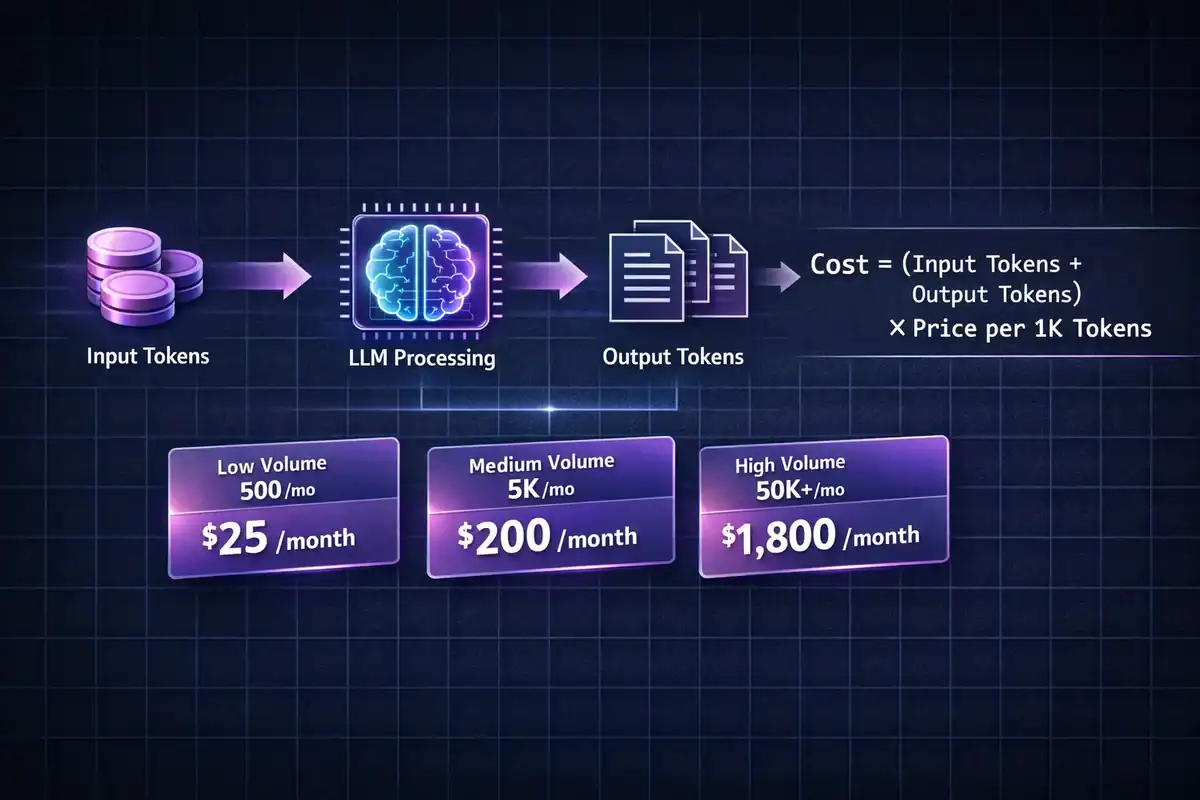
What Are Tokens?
Tokens are the units LLMs use to process text. Roughly 1,000 tokens equals 750 words. There are three types to budget for:
- Input tokens: The text you send to the model (your prompt, context, retrieved documents).
- Output tokens: The text the model generates in response. Usually 2–3x more expensive than input tokens.
- Reasoning tokens: Used by models like o3-mini and o3 and Claude’s extended thinking mode. These are hidden ‘thinking’ steps the model takes before responding. They can add 50–200% to your token bill for complex tasks.”
The Cost-Per-Interaction Formula
Cost per 1,000 interactions =
  (avg input tokens × input rate per token)
  + (avg output tokens × output rate per token)
  + (tool call overhead)
Worked example (GPT-4o pricing, 2026 rates):
- Average input per interaction: 2,000 tokens × $0.0025/1K = $0.005
- Average output per interaction: 500 tokens × $0.010/1K = $0.005
- Tool call overhead (2 calls × $0.002): $0.004
- Cost per interaction: ~$0.014
- Cost per 1,000 interactions: ~$14
With Llama 3 (self-hosted or via managed inference), the same interaction might cost $0.003–$0.007 – a 3–7x reduction.
Three Volume Scenarios
Volume | Interactions / Month |
Estimate
LLM Cost (API Model)
USD · per month |
Estimate
LLM Cost (Open-Source)
USD · per month |
|---|---|---|---|
|
Low
Starter | 500 | $50 – $300/mo | $15 – $100/mo |
|
Medium
Growth | 5,000 | $400 – $2,500/mo | $120 – $800/mo |
|
High
Enterprise | 50,000+ | $3,000 – $20,000+/mo | $900 – $6,000+/mo |
Estimates based on typical LLM API pricing and self-hosted infrastructure costs · Actual costs vary by model choice, token usage, and hosting region · Open-source costs reflect compute/hosting only
At high volume, model choice becomes a major financial lever. IDC forecasts a 10x increase in enterprise AI agent usage by 2027 – with a corresponding 1,000x increase in agent-related inference and API loads – which means teams that don’t plan their token economics now will face painful cost surprises later.
Infrastructure Costs to Budget For
Beyond LLM API costs, budget for:
- Vector database (Pinecone, Weaviate, Chroma, Qdrant): $70–$500/month depending on data volume.
- Compute (cloud GPU or managed inference): $100–$3,000/month depending on whether you self-host models.
- Logging and observability (LangSmith, Helicone, Datadog, Arize AI): $100–$800/month.
- Orchestration layer (LangChain/LangGraph hosting, AutoGen runtime): $50–$500/month.
Deployment Size |
Estimate
Monthly Infrastructure Cost
USD · based on market averages |
|---|---|
| Small Internal · low volume Starter | $200 – $800/mo |
| Medium Team-wide · moderate volume Growth | $800 – $3,000/mo |
| Large Customer-facing · high volume Enterprise | $3,000 – $15,000+/mo |
Estimates based on typical cloud infrastructure and hosting market rates · Costs vary by provider, region, redundancy requirements, and traffic patterns · Excludes LLM API or model licensing fees
Important: At scale, ongoing OpEx often exceeds the initial build cost within 18–24 months. The architecture decisions you make at the start especially model choice and vector database design directly determine your long-term unit economics.
Build vs. Buy vs. Hybrid: Which Approach Fits Your Budget?
The right approach depends on your volume, customization needs, and data sensitivity.
✅Platform Agents (Buy)
Tools like Intercom Fin, Zendesk AI, and Salesforce Agentforce are fast to deploy and require zero build cost. Pricing is typically $50–$500/month per seat or usage-based.
Best for: Teams that want to validate AI agent ROI quickly without engineering investment.
Limitations: Low customization, limited data ownership, per-seat costs become expensive at scale.
✅Custom Agents (Build)
High upfront CapEx ($30,000–$400,000+), lower per-interaction costs at scale, full flexibility, and full data control. Longer build cycles and requires ongoing maintenance.
Best for: High-volume workflows, sensitive data environments, or workflows that are genuinely differentiated from what platforms offer.
✅Hybrid Approach
Start on a platform to validate ROI. Then build custom agents for the highest-value, highest-volume workflows where platform costs become prohibitive or customization is essential.
When to switch from platform to custom: When monthly platform licensing exceeds $3,000–$5,000/month AND the workflow is strategic enough to warrant ownership.
3-Year Total Cost of Ownership (TCO) Comparison
(Approximate estimates – actual costs vary by use case and vendor)
Approach |
Low Usage
500 / month
USD · annual cost |
Medium Usage
5,000 / month
USD · annual cost |
High Usage
50,000+ / month
USD · annual cost |
|---|---|---|---|
| Platform-only No Build Cost |
Annual
$1,800 – $6,000/yr |
Annual
$12,000 – $36,000/yr |
Annual
$60,000 – $180,000/yr |
| Custom-only High Build Cost |
Year 1
$40,000 – $80,000
Then ongoing
$8,000 – $20,000/yr |
Year 1
$40,000 – $80,000
Then ongoing
$15,000 – $40,000/yr |
Year 1
$60,000 – $150,000
Then ongoing
$30,000 – $80,000/yr |
| Hybrid Balanced |
Year 1
$20,000 – $50,000
Then ongoing
$5,000 – $15,000/yr |
Year 1
$30,000 – $70,000
Then ongoing
$12,000 – $30,000/yr |
Year 1
$50,000 – $120,000
Then ongoing
$25,000 – $60,000/yr |
Estimates based on typical agency, platform, and infrastructure market rates · Year 1 costs include build and setup · Ongoing costs reflect hosting, maintenance, and LLM usage · Actual costs vary by vendor, region, and complexity
At low volume, platform-only wins on year-1 cost. At medium and high volume, custom or hybrid becomes more cost-effective by year 2–3.
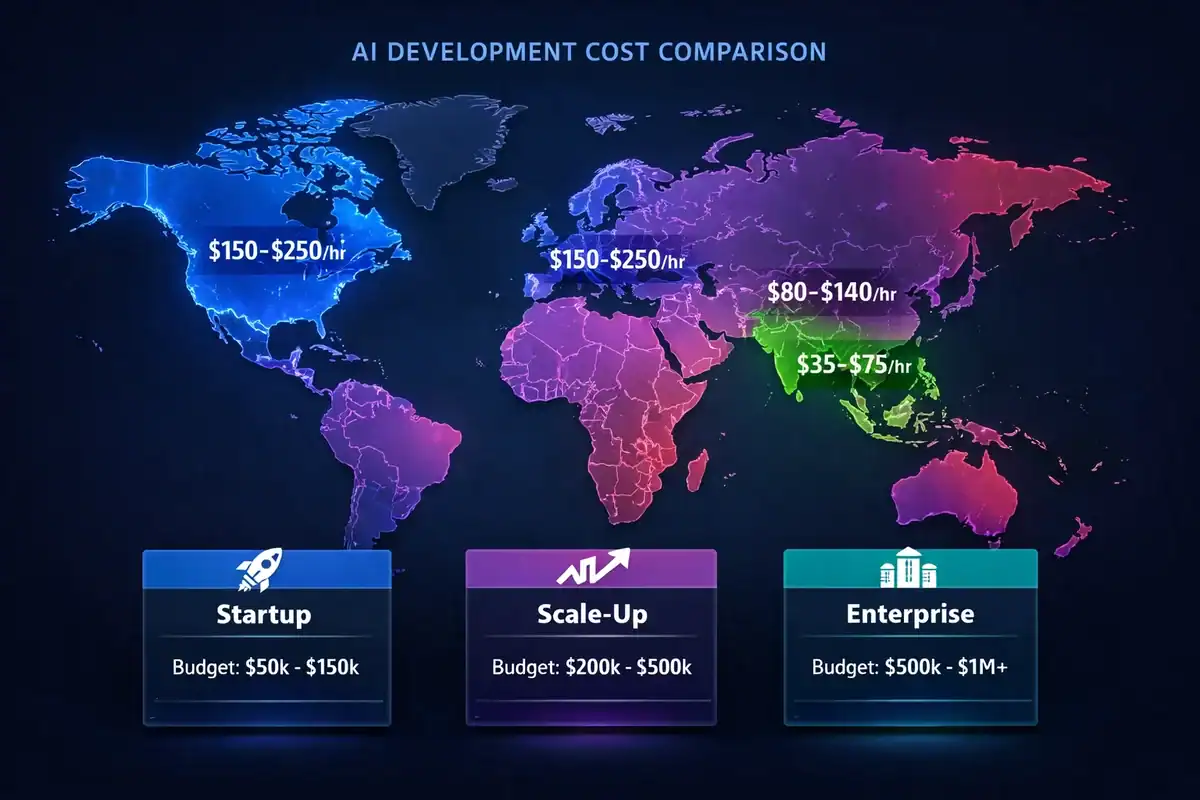
Regional Cost Comparison: Where Should You Build?
No single competitor puts all regions side by side. Here’s the full picture.
Region / Model |
Benchmark
Senior AI Engineer Rate
USD · hourly or annual |
Project Cost
Typical Workflow Agent Cost
USD · full build estimate |
Signal
Quality Signal
Expected output standard |
Overhead
Communication
Coordination effort |
|---|---|---|---|---|
| US / EU In-house or Agency | $150 – $250/hr | $80,000 – $300,000+ | ⭐ Highest | ✅ Lowest |
| India-based Agency | $35 – $75/hr | $20,000 – $80,000 | ⚠️ Variable Vet carefully | 🔶 Medium |
| Hybrid Western PM + India Eng | $60 – $100/hr blended rate | $35,000 – $120,000 | ✅ High With right vetting | 🔵 Low–Medium |
| Freelancers Independent | $50 – $150/hr | $15,000 – $30,000 PoC / MVP only | ⚠️ Variable | 🔴 Medium–High |
| In-house (US/EU) Salaried Team | $150,000 – $250,000/yr | N/A Salary cost model | ⭐ Highest | ✅ None |
| In-house (India) Salaried Team | $40,000 – $90,000/yr | N/A Salary cost model | ✅ High With good hiring | ✅ Low |
Rates based on 2024–2025 market benchmarks · Hourly rates reflect senior AI/ML engineer profiles · Annual salaries exclude benefits, equity, and overhead · Agent build costs vary by scope, integrations, and complexity
Key guidance:
- US/EU agencies are worth the premium for regulated industries or complex multi-agent systems where miscommunication is costly.
- India-based agencies offer strong value – but specifically vet for LangChain, LangGraph, and RAG pipeline experience. Generic software shops are not AI agent specialists.
- Hybrid model is often the best value for mid-market buyers. A Western architect and PM reduces communication overhead while offshore engineering reduces burn rate.
- Freelancers work well for scoped PoC components but carry delivery risk for production multi-integration systems.
- In-house hiring is justified if you plan to build 3+ agents over 24 months or if your data is too sensitive to share with external vendors.
Roadmaps by Company Stage: Startup, Scale-Up, Enterprise
Your stage determines your strategy. Here’s what each path should look like.
✅Startup: $8,000–$30,000 First Agent
Budget reality: Your first agent should validate one hypothesis, not transform your company.
Recommended first agents:
- Internal knowledge Q&A (team FAQ bot)
- Basic lead qualification
- Support ticket triage
Acceptable shortcuts at this stage:
- Use a platform agent first (Intercom Fin, Zendesk AI) to validate ROI before building custom
- Skip RAG initially if your unstructured data is limited
- Use managed APIs (no self-hosting) – AWS Bedrock or Azure AI Studio are fine
- Limit autonomy to assisted mode only
Red line: Do not build a customer-facing autonomous agent as your first project. The failure cost – in user trust, support overhead, and debugging time is too high.
✅Scale-Up: $50,000–$200,000 Over 12 Months
Budget reality: You’ve validated the concept. Now you’re building for real business impact across 1–3 agents.
Recommended sequencing:
- Support deflection agent (internal, high volume, measurable ROI)
- Sales prospecting agent (revenue-impacting, builds on CRM integration from agent #1)
- Ops automation agent (efficiency-focused, shares infrastructure from agents #1 and #2)
Key risk to avoid: Building agent #2 on a different framework from agent #1. This creates architecture debt that makes multi-agent orchestration expensive later. Standardize on one orchestration layer (LangGraph or AutoGen) from the start.
IDC’s forecasts note that 40–60% of AI OpEx stems from integration and maintenance costs – unified infrastructure is not optional at this stage.
✅Enterprise: $150,000–$500,000+ Multi-Agent Initiative
Budget reality: This is a portfolio, not a project. You’re building infrastructure that multiple agents will share.
Priority order:
- Governance first. Define who approves agent actions, what gets logged, how hallucinations are caught, and how agents are audited – before building anything.
- Shared infrastructure. One vector database, one orchestration layer, one observability stack. Every agent you add should cost less than the previous one.
- Compliance layer. Budget $30,000–$80,000 for security reviews, data governance frameworks, and human-in-the-loop workflow design in regulated industries.
Ongoing OpEx: $50,000–$150,000/year in infrastructure, governance, and compliance work.
Forrester anticipates half of enterprise ERP vendors will launch autonomous governance modules in 2026 – evaluate whether your ERP vendor’s native agent tools reduce your build cost before committing to a fully custom approach.
Risk, Compliance, and Underestimated Costs
These are the costs that blow budgets. Every team that skips this section regrets it.
✅Data Security and Access Control
Who can the agent see? Least-privilege access design – giving the agent access only to what it needs – adds engineering time but is critical.
Budget: $5,000–$20,000 depending on system complexity.
✅Auditability and Logging
Regulated industries need full audit trails of every agent decision. Standard observability tools (Datadog, LangSmith) don’t cover this out of the box.
Budget: $10,000–$30,000 for custom logging infrastructure.
✅Human-in-the-Loop Design
Integrating approval workflows into agent actions (especially for finance, legal, and HR) is not trivial. It requires UI components, notification systems, and timeout handling.
Budget: $8,000–$25,000 per agent workflow.
✅Legal and Compliance Review
- GDPR Data Protection Impact Assessment: $10,000–$20,000
- HIPAA BAA agreements and controls: $15,000–$30,000
- EU AI Act Article 13 transparency requirements: $10,000–$25,000
Total compliance consulting budget for regulated deployments: $10,000–$40,000.
✅Monitoring for Hallucinations, Drift, and Misuse
Production AI agents drift over time. Model updates, data changes, and edge cases cause behavior to shift. Tools like LangSmith, Helicone, and Arize AI catch this – but they cost money.
Budget: $500–$3,000/month depending on volume. Do not skip this.
✅Failure-Mode Budget
Arkose Labs’ 2026 Agentic AI Security report found that 97% of enterprise leaders expect a material AI-agent-driven security incident within 12 months. Runaway token usage, mis-scoped automation, and hallucination-related errors are real failure modes.
Always allocate 15–20% of your build budget as a contingency for mis-scoped integrations, unexpected data quality issues, and rollback planning. Teams that skip this consistently go over budget.
Scoping Checklist: Estimate Your Own Cost Before Talking to a Vendor
Work through these six steps before you get your first vendor quote. This gives you a baseline to negotiate from.
✅Step 1: Define One Primary Goal and 1–3 Measurable KPIs
Don’t write “improve efficiency.” Write “reduce ticket resolution time by 30%” or “reclaim 15 FTE hours per week on reconciliation.” If you can’t define a specific metric, you’re not ready to scope a project.
✅Step 2: Map the Workflows
Write out every step the agent will handle. Include decision points (“if the customer asks about billing, route to X”) and exception scenarios (“if the system returns an error, do Y”). Count the number of branches. More branches = higher cost.
✅Step 3: List Every Data Source and System
Write down every system the agent needs to access. For each one, answer: Does an API exist? Is the data clean and structured? Is it real-time or batch? Be honest. Messy data is expensive.
✅Step 4: Decide Your Autonomy Threshold
For each action the agent might take, decide: can it act independently, or does a human need to confirm? Write this down. It directly determines your reliability engineering budget.
✅Step 5: Choose Your Approach
- Platform agent: Fast, constrained, $50–$500/month. Best for validation.
- Custom agent: Flexible, expensive, $30,000–$400,000+. Best for scale and control.
- Hybrid: Start on platform, migrate custom when ROI is proven.
✅Step 6: Build Your Preliminary Budget
Use the cost bands from this article:
- Pick your tier (PoC / Workflow / Multi-Agent)
- Add integration complexity (roughly $5,000–$15,000 per complex integration)
- Add compliance costs if applicable
- Add 12-month OpEx estimate (use the token economics formula above)
- Add 15–20% contingency
This number is your vendor negotiation baseline. If a vendor quotes significantly above it, ask them to justify the delta line by line.
Frequently Asked Questions
How much does an autonomous AI agent cost to run per month on GPT-4 API?
A low-volume assisted agent (1,000–3,000 tasks/month) costs roughly $150–$600/month on GPT-4o. A semi-autonomous agent at 5,000–15,000 tasks runs $1,200–$5,500/month. A fully autonomous high-volume agent (10,000–50,000+ tasks) can reach $4,000–$22,000+/month. Costs multiply vs. simple chatbots because each user request triggers 3–10 internal LLM calls for planning, tool use, and error recovery.
What is the minimum realistic budget to prototype an AI agent in 2026?
The minimum realistic budget for a working PoC is $8,000–$15,000. Below $8,000, you’re likely getting a chatbot wrapper, not a true agent with tool use and memory. Budget $15,000–$25,000 if you need even one real integration.
How much does it cost to run an AI agent per 1,000 conversations?
Using a frontier API model (GPT-4o, Claude Sonnet), expect $15–$50 per 1,000 conversations depending on conversation length and tool calls. With a self-hosted open-source model (Llama 3, Mistral), costs drop to $3–$12 per 1,000 conversations at equivalent quality for well-defined tasks.
How do AI agent costs differ between India, the US, and Europe?
India-based specialist agencies charge $35–$75/hour for senior AI engineers, making equivalent projects 40–60% cheaper than US/EU teams ($150–$250/hour). Quality varies – vet specifically for LangChain, LangGraph, and RAG experience. A hybrid model (Western PM + India engineering) often delivers the best value for mid-market buyers
When does it make sense to move from a platform agent to a custom build?
When your monthly platform licensing exceeds $3,000–$5,000/month AND the workflow is strategic enough to warrant data ownership and customization. At that spend level, a custom build typically pays back within 12–18 months.
How do open-source models compare to managed APIs over a 3-year cost horizon?
At low volume (under 2,000 interactions/month), managed APIs (GPT-4o, Claude) are cheaper when you factor in the setup cost of self-hosting. At medium-to-high volume (5,000+ interactions/month), a well-tuned open-source model (Llama 3, Mistral) can reduce per-token costs by 3–10x, making the self-hosting investment worthwhile within 12–18 months.
What are the most common hidden costs teams forget to budget for?
The top five are: (1) data cleaning and preparation for RAG pipelines, (2) human-in-the-loop approval workflow design, (3) compliance and legal review, (4) ongoing monitoring for hallucinations and drift, and (5) the 15–20% contingency for mis-scoped integrations. These routinely add 20–35% to initial estimates.
How much extra does it cost to make an AI agent multilingual?
Adding multilingual support (3–5 languages) typically adds $5,000–$20,000 to build cost, depending on whether you rely on the LLM’s native multilingual capability or build language-specific prompt layers. Ongoing token costs increase 10–30% due to longer prompts in some languages.
What does adding human-in-the-loop approval workflows cost to build?
Budget $8,000–$25,000 per agent workflow. This includes UI components for reviewers, notification systems (email/Slack), timeout handling, and audit logging of approval decisions. Finance and legal use cases sit at the upper end of this range.
How long does it typically take to build and launch an AI agent?
A PoC takes 4–10 weeks. A workflow agent takes 8–20 weeks. A multi-agent system takes 20–40+ weeks. These timelines assume a dedicated team and clear scope – scope changes mid-build add 20–40% to timelines.
What is the cost impact of choosing a frontier model vs. a fine-tuned open-source model?
At 50,000 interactions/month, a frontier API model might cost $5,000–$15,000/month in LLM costs. A fine-tuned open-source model (Llama 3, Mistral) on managed inference might cost $800–$3,000/month for the same volume – a 3–10x difference. The fine-tuning setup costs $10,000–$40,000 upfront but pays back within 3–9 months at high volume.
Interactive AI Agent Cost Calculator
Use the calculator below to estimate your build and operating costs based on your specific situation.
This calculator provides directional guidance only – not a formal quote.
Conclusion: What to Do Next
Here is the honest summary: how much it costs to build an AI agent in 2026 depends almost entirely on decisions you make before writing a single line of code.
The biggest cost mistakes teams make are:
- Scoping too broadly on the first project. Start with one workflow, one goal, and two integrations maximum.
- Ignoring token economics until the invoice arrives. Run the cost-per-interaction math before you choose your model.
- Skipping the contingency budget. 15–20% of your build cost should be held back for the unexpected – because something unexpected always happens.
- Building for autonomy before trust is established. Start in assisted mode. Earn the right to remove the human from the loop.
- Treating compliance as an afterthought. In regulated industries, governance is not optional – and it’s far cheaper to design for it upfront than to retrofit it later.
The companies that get the most value from AI agents in 2026 are not the ones that build the most sophisticated systems first. They’re the ones that scope precisely, instrument carefully, prove ROI on agent #1, and use that proof to fund agents #2 and #3 with better architecture and lower risk.
Your next steps:
- Work through the 6-step scoping checklist above before talking to any vendor.
- Use the interactive calculator to build your preliminary budget range.
- If your estimated build cost is above $50,000, request a line-item breakdown from at least two vendors before committing.
- If you’re in a regulated industry, engage a compliance consultant before scoping the technical work.
The AI agent market is moving fast – analyst and survey data suggest around 40% of companies plan to deploy within 12 months. But speed without scope discipline is the primary reason over 40% of projects are projected to fail by 2027. Take the time to scope well. The ROI will follow.

Shivakumar K Naik is an SEO Analyst and Technology Writer based in Mysore, Karnataka with 2.5+ years of experience and 28+ client success stories across FinTech, Travel, Automotive, SaaS and Education. He has delivered 150+ Google first-page rankings for brands like Mudrex, Decathlon and Maruti Suzuki. On Tech Caffeine, he writes practical, beginner-friendly guides on AI tools, how to make money online with AI, cryptocurrency, blockchain, NFTs, gaming and emerging technology content built from real SEO experience and daily hands-on use of ChatGPT, Claude, Ahrefs and Semrush.