Last updated: April 25, 2026
Quick Answer: SEO, GEO, AEO, and AIO are four overlapping but distinct layers of search visibility. SEO wins Google rankings. AEO wins direct-answer slots like featured snippets. GEO wins citations inside generative AI tools like ChatGPT and Perplexity. AIO is the umbrella framework covering all AI-driven discovery. You don’t have to choose just one but you do need to know which to fix first.
Key Takeaways
- SEO is still the foundation. If Google can’t index you, ChatGPT probably can’t cite you either.
- AEO targets featured snippets and voice answers. It’s been a real discipline since 2019 and delivers results in 1–3 months.
- GEO is new but legitimate. It focuses on getting your brand cited inside AI-generated responses on ChatGPT, Perplexity, and Gemini.
- AIO is mostly a strategic framework, not a separate channel. Be skeptical of agencies selling it as a standalone service.
- Fix your lowest-scoring layer first. The 20-question audit in Section 7 tells you exactly where to start.
- GEO doesn’t always drive clicks. It drives brand mentions and pipeline influence – measure it differently than SEO.
- AI citation sources change frequently. Nate Elliott at EMARKETER notes that 40–60% of sources cited in AI responses change month to month.
- Budget matters. Startups should spend $500–$2K/month on SEO before touching GEO or AIO.
- The industry hasn’t agreed on definitions. AIO, LLMO, and AISO are contested terms. This guide cuts through the noise.
- You can test your AI visibility today using the 10 copy-paste prompts in Section 13.
TL;DR – The 30-Second Answer
SEO, GEO, AEO, and AIO are not competing strategies. They are four layers of a visibility stack. Each layer builds on the one below it.

The 8-Dimension Comparison Table
Who Should Read What
- “I need to decide where to invest first” → Jump to Section 7 (the 4-Layer Visibility Audit).
- “I run a local business or specific industry” → Jump to Section 8 (Industry Playbooks).
- “My boss asked me to figure out AI SEO” → Read the whole thing. Start here.
These four disciplines overlap significantly. But they are distinct enough that a team can – and often does invest in the wrong one first. This guide helps you avoid that.
SEO vs GEO vs AEO vs AIO: What Do They Actually Mean?

Each acronym targets a different part of how people find information today. Here are clean, usable definitions for all four – plus three adjacent terms that keep showing up in agency pitches.
✅SEO (Search Engine Optimization)

SEO is the discipline of optimizing content and websites to rank higher in traditional search engine results on Google and Bing.
SEO has been around since the mid-1990s. It covers three main areas: technical health (site speed, crawlability, indexing), on-page content (keywords, headings, meta tags), and off-page authority (backlinks from other websites).
Where it shows up: Google organic results, Bing, DuckDuckGo, Yahoo.
Example queries:
- “best CRM software for small business”
- “how to fix a leaking pipe”
What winning looks like: Your page ranks in positions 1–3 for a target keyword. You get consistent organic traffic every month without paying for ads.
✅AEO (Answer Engine Optimization)
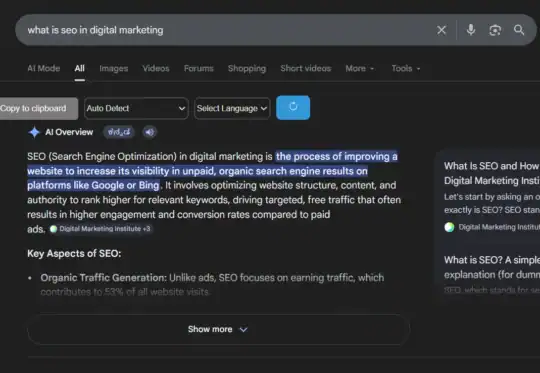
AEO is the discipline of optimizing content to be selected as the direct answer in featured snippets, voice assistants, and People Also Ask boxes.
AEO focuses on how search engines extract and display answers directly on the results page – without requiring the user to click through. It became a real discipline around 2019 when voice search and featured snippets grew significantly.
Where it shows up: Google featured snippets, People Also Ask boxes, Siri, Alexa, Google Assistant.
Example queries (voice-style):
- “What is the best time to water plants?”
- “How long does a passport renewal take?”
What winning looks like: Your answer appears in the featured snippet box at the top of Google. A voice assistant reads your answer aloud when someone asks a related question.
✅GEO (Generative Engine Optimization)

GEO is the discipline of optimizing content to be cited and referenced by generative AI tools like ChatGPT, Perplexity, and Google Gemini. In practice, this means treating generative engine optimisation as a complete discipline rather than just a set of isolated content tweaks.
GEO emerged in 2023 when large language models (LLMs) – AI systems trained on massive amounts of text – became widely used for research and discovery. Kelsey Voss at EMARKETER describes GEO as optimizing for synthesized answers rather than clicks, and recommends tracking citations and share of voice over traffic.
Where it shows up: ChatGPT, Perplexity, Google Gemini, Google AI Mode, Claude, Meta AI, Bing Copilot.
Example queries:
- “What are the best project management tools for remote teams?”
- “Which skincare ingredients help with hyperpigmentation?”
What winning looks like: When a user asks ChatGPT or Perplexity about your product category, your brand is mentioned by name – ideally with a link or citation.
✅AIO (Artificial Intelligence Optimization)
AIO is the umbrella discipline covering all tactics that help a brand be discovered, trusted, and recommended across the full AI ecosystem – including search, chatbots, voice, and AI agents.
AIO is the broadest of the four terms. It encompasses SEO, AEO, and GEO, plus additional signals like review management, entity consistency, and Knowledge Graph presence. The industry hasn’t reached consensus on AIO’s exact definition, and it is sometimes used as agency repackaging of existing services.
Where it shows up: All platforms listed above, plus agentic AI workflows (AI systems that take actions on a user’s behalf).
Example queries:
- “Find me a reliable plumber in Austin and book an appointment”
- “What software does [company type] typically use for [function]?”
What winning looks like: Your brand is consistently recommended across ChatGPT, Perplexity, Google AI Overviews, and voice assistants – and the information about you is accurate everywhere.
What About LLMO, AISO, and SXO?
These three terms appear often enough that they deserve a quick definition.
- LLMO (Large Language Model Optimization) is a practical synonym for GEO. It refers specifically to optimizing for how large language models like GPT-4 and Claude select and cite sources.
- AISO (AI Search Optimization) is SurferSEO’s branded term for AI-era SEO. It covers similar ground to GEO and AIO but is specific to Surfer’s methodology.
- SXO (Search Experience Optimization) is a UX-focused approach that combines SEO with user experience design. It predates the AI search wave and focuses on reducing friction between search and conversion.
The Search Visibility Stack: How the Four Layers Connect
The four disciplines are not competitors. They are layers in a stack, and each layer depends on the one below it.
Think of it this way: a building needs a foundation before it can have walls, a roof, or interior design. The same logic applies here.
Layer 1 – SEO (Foundation): Your site is crawlable, indexed, and ranks for relevant keywords. Without this, nothing else works reliably.
Layer 2 – AEO (Structure): Your content is formatted to answer specific questions directly. This captures featured snippets, People Also Ask boxes, and voice queries.
Layer 3 – GEO (Reach): Your content is structured, authoritative, and widely cited enough that AI tools pull it into generated responses.
Layer 4 – AIO (Umbrella): Your brand signals – reviews, entity data, cross-platform mentions – are consistent and strong enough to be recommended across the full AI ecosystem.
The key dependency: If Google can’t index your pages, ChatGPT probably can’t cite you either. Most LLMs use web-crawled data as part of their training and retrieval systems. A weak SEO foundation means weak GEO performance. Lily Ray, VP of SEO at Amsive, confirms that GEO tactics strongly overlap with SEO fundamentals like structure and authority.
The Visibility Score Formula
Use this formula to get a rough sense of where you stand:
Visibility Score = (SEO rank score × 0.3) + (AEO capture rate × 0.25) + (GEO citation share × 0.25) + (AIO signals × 0.2)
Variable definitions:
- SEO rank score: Average position for your top 20 target keywords (invert it: position 1 = 100, position 10 = 50, etc.)
- AEO capture rate: Percentage of your target question queries where you hold the featured snippet or PAA box
- GEO citation share: Percentage of AI responses about your category that mention your brand
- AIO signals: Composite score based on review count, Knowledge Graph presence, and cross-platform consistency
This formula is a planning tool, not a precise measurement. Use it to identify which layer is dragging your overall score down.
Side-by-Side Comparison: SEO vs GEO vs AEO vs AIO

The table in the TL;DR section covers the eight core dimensions. Here are five more dimensions that matter for teams deciding how to allocate resources.
Three key takeaways from this comparison:
First, SEO is the only layer with straightforward traffic attribution. Every other layer involves some degree of indirect influence. Second, GEO and AIO require the most cross-functional effort – they touch PR, brand, and content simultaneously. Third, if your team has limited bandwidth, SEO and AEO give you the clearest return on effort.
Why These Acronyms Exist – And Which Are Real vs Hype?
The short history: SEO emerged around 1997 as search engines became mainstream. AEO became a recognized discipline around 2019 when Google’s featured snippets and voice assistants grew significantly. GEO and LLMO emerged in 2023 following the rapid adoption of ChatGPT and other large language models. AIO appeared in 2024 as agencies sought an umbrella term for AI-era optimization.
Here is an honest audit of each term:
| Dimension | SEO | AEO | GEO | AIO |
|---|---|---|---|---|
| Team skills needed | Technical SEO, content writing, link building | Content strategy, schema markup, UX writing | Content strategy, data creation, PR/outreach | Brand management, reputation management, entity SEO |
| Primary content formats | Long-form articles, landing pages, product pages | FAQ pages, how-to guides, definition posts | Original research, comparison content, data-driven posts | Press releases, reviews, social profiles, directory listings |
| Primary audience | Search engines + human readers | Search engines extracting answers | AI training & retrieval systems | AI recommendation systems |
| Dependency | None (foundation) | Requires SEO | Requires SEO + AEO | Requires all layers |
| Attribution difficulty | Low (GSC trackable) | Medium (snippet tools) | High (no direct clicks) | Very high (brand influence) |
There is an active debate in the industry about which terms are legitimate. Graphite.io (led by Ethan Smith) and AthenaHQ (led by Alan Yao) have both published frameworks for GEO and AI citation optimization. SurferSEO uses AISO as its branded approach. EMARKETER’s Peter Clark notes that terms like AIO overlap heavily with no standard taxonomy.
The practical conclusion: treat SEO, AEO, and GEO as three real, distinct disciplines. Treat AIO as a strategic framework – useful for planning, but not a separate channel you can buy as a service. If an agency is selling you “AIO” without explaining exactly which tactics they’re using, ask them to break it down into SEO, AEO, and GEO components.
How Do You Optimize for Each Layer?
Each layer has specific tactics. Generic advice like “create quality content” doesn’t help you decide what to do on Monday morning. Here are concrete actions for each layer.
✅Optimizing for SEO
SEO covers three areas: technical health, content quality, and off-page authority.
7 specific tactics:
- Run a technical audit. Use Screaming Frog or Semrush to find broken links, duplicate title tags, missing meta descriptions, and crawl errors.
- Fix Core Web Vitals. Google uses page speed and visual stability as ranking signals. Check your scores in Google Search Console under “Experience.”
- Build topical authority clusters. Create a pillar page on a broad topic, then write 8–12 supporting articles on subtopics. Link them together.
- Target long-tail keywords. Pages targeting specific 4–6 word queries convert better and rank faster than broad single-word terms.
- Earn backlinks through original data. Publish a survey, study, or proprietary dataset. Other sites cite original data, which builds domain authority.
- Optimize title tags and meta descriptions. Include your primary keyword in the title tag within the first 60 characters.
- Fix your internal linking. Make sure every important page has at least 3 internal links pointing to it from other relevant pages.
Tool recommendation: Google Search Console (free) for indexing and performance data. Semrush or Ahrefs for keyword research and backlink analysis.
Common mistake: Fixing technical issues on pages that don’t matter. Prioritize pages with existing traffic or commercial intent first.
Quick win this week: Open Google Search Console. Go to “Coverage.” Fix any pages marked as “Excluded” that should be indexed.
✅Optimizing for AEO
AEO is about formatting your content so search engines can extract and display it as a direct answer.
6 specific tactics:
- Answer the query in the first 50 words. Every article should open with a direct 1–2 sentence answer before any background or context.
- Use question-format H2 and H3 headings. “How does X work?” performs better for featured snippets than “Overview of X.”
- Add FAQ schema to FAQ pages. FAQ schema (from Schema.org) tells Google that your page contains question-and-answer pairs. This increases your chance of appearing in People Also Ask boxes.
- Write 40–60 word definition blocks. Google often pulls featured snippets from concise, self-contained paragraphs. Write these deliberately.
- Use numbered lists for process content. “How to” content in numbered list format is frequently pulled into featured snippets.
- Target People Also Ask (PAA) boxes. Use AlsoAsked.com to find PAA questions related to your topic. Write dedicated sections answering each one.
Tool recommendation: AlsoAsked.com for PAA research. SurferSEO for on-page content optimization and snippet gap analysis.
Common mistake: Adding FAQ schema to pages where the answers are too long or vague. Google needs a clean, direct answer – not a paragraph that says “it depends.”
Quick win this week: Rewrite the opening paragraph of your top 5 blog posts. Make sure each one answers the query directly in the first two sentences.
✅Optimizing for GEO
GEO is about making your content the kind of source that AI tools trust and cite. Aja Frost, senior director at HubSpot, recommends prioritizing answer-first content and brand mentions on social and review sites over backlinks for GEO and AEO.
7 specific tactics:
- Use answer-first structure throughout. Every section should open with the answer, then expand. AI retrieval systems (called RAG – Retrieval-Augmented Generation) pull the most answer-dense passages.
- Build topical authority with content clusters. Cover a topic comprehensively. AI tools favor sources that cover a subject in depth, not just one article.
- Create original, quotable data. Publish surveys, benchmarks, or case study statistics. AI tools cite specific numbers because they’re more trustworthy than vague claims. Bolded stat: 40–60% of sources cited in AI responses change month to month, making fresh, original data especially valuable.
- Clarify your entity. Make sure your brand name, product names, and key people are consistently named across your website, social profiles, Wikipedia, Wikidata, and Crunchbase. AI tools use entity recognition to decide who to cite.
- Build presence on Reddit, YouTube, and Quora. These platforms are heavily indexed by AI tools. A thread on Reddit where your product is mentioned positively can influence AI citations.
- Set up an llms.txt file. The llms.txt proposal (still being debated as of 2026) is a text file placed at your domain root that guides AI tools on how to use your content. It’s worth implementing even while the standard is evolving.
- Check your robots.txt for AI crawlers. Make sure you are not accidentally blocking GPTBot (OpenAI), CCBot (Common Crawl), PerplexityBot, Google-Extended, ClaudeBot, or Amazonbot. Blocking these crawlers cuts off your GEO potential entirely.
Tool recommendation: Profound or AthenaHQ for tracking AI citation share and monitoring where your brand appears in AI responses.
Common mistake: Blocking AI crawlers in robots.txt without realizing it. Many sites added broad bot-blocking rules after the AI boom in 2023. Check your robots.txt file today.
Quick win this week: Open ChatGPT or Perplexity and type “What are the best [your category] for [your target customer]?” Log which brands appear. If yours doesn’t, that’s your baseline.
✅Optimizing for AIO
AIO focuses on the brand-level signals that AI systems use to decide whether to recommend you.
6 specific tactics:
- Ensure NAP consistency. Ensure entity consistency across the web. Your brand name, product names, founder names, and category descriptors should be identical everywhere – website, LinkedIn, Crunchbase, Wikipedia, Wikidata, G2, press coverage, and social profiles. AI systems use entity recognition to decide who you are and what you do. Inconsistent naming (e.g., “Acme Inc.” vs. “Acme Corp” vs. “Acme”) fragments your entity profile and weakens citation likelihood. For local or service businesses, this includes NAP (Name, Address, Phone) consistency across directories like Google Business Profile and Yelp.
- Claim your Knowledge Graph entry. Search for your brand on Google. If a Knowledge Panel appears, claim it through Google Search Console. If it doesn’t exist, create or update your Wikipedia/Wikidata entry.
- Monitor brand mentions across the web. Use Ahrefs Brand Radar or Peec AI to track where your brand is mentioned online. Unlinked mentions still influence AI training data.
- Generate and respond to reviews. Review volume and recency are signals that AI tools use to assess brand credibility. Aim for a consistent flow of new reviews on Google, G2, Trustpilot, or industry-specific platforms.
- Publish consistent content across platforms. A brand that appears on its own blog, LinkedIn, YouTube, and industry publications is more likely to be recognized as an authority by AI systems.
- Use Organization and Person schema. These Schema.org markup types help AI systems understand who you are, what you do, and who works at your company.
Tool recommendation: Ahrefs Brand Radar for mention monitoring. Peec AI for AI-specific brand visibility tracking.
Common mistake: Treating AIO as a separate channel with a separate budget. AIO is the result of doing SEO, AEO, and GEO well – not a fourth thing to buy.
Quick win this week: Search for your brand name on Google. Check your Wikipedia entry, Wikidata listing, and Crunchbase profile. Update any outdated or missing information.
4-Layer Visibility Audit – Score Your Current State
This 20-question audit takes about 15 minutes. Answer yes (1 point) or no (0 points) for each question. Your total score tells you which layer to fix first.
✅SEO Layer (5 questions)
- Do all your key pages have unique, keyword-relevant title tags under 60 characters?
- Is your site fully indexed by Google (check Google Search Console → Coverage)?
- Do you have a backlink profile with 50 or more referring domains from relevant sites?
- Does your site load in under 3 seconds on mobile (check PageSpeed Insights)?
- Do you have a clear content cluster structure – at least one pillar page with 5+ supporting articles?
✅AEO Layer (5 questions)
- Do your articles answer the main query in the first 50 words?
- Do you use FAQ schema markup on pages that contain question-and-answer content?
- Do you have at least 10 pages specifically targeting question-format queries (“how to,” “what is,” “why does”)?
- Have you researched People Also Ask boxes for your top 20 target queries?
- Is your content formatted with numbered lists or definition blocks where relevant?
✅GEO Layer (5 questions)
- Have you queried ChatGPT and Perplexity for your top 10 category terms and logged the results?
- Is GPTBot allowed in your robots.txt file (not blocked)?
- Do you have original data, statistics, or research published on your site that other sources could cite?
- Is your brand entity clearly defined – consistent name, description, and founding details across your website, Wikipedia, and Wikidata?
- Does your brand have a presence on Reddit, YouTube, or Quora where your products or services are discussed positively?
✅AIO Layer (5 questions)
- Is your brand listed in Google’s Knowledge Graph (does a Knowledge Panel appear when you search your brand name)?
- Do you have 50 or more Google reviews with an average rating of 4.0 or higher?
- Is your NAP data (Name, Address, Phone) consistent across 20 or more online directories?
- Do you use Organization schema or Person schema markup on your website?
- Are you monitoring unlinked brand mentions across the web using a tool like Ahrefs or Google Alerts?
Score Interpretation
| Score | Status | Action |
|---|---|---|
| 0–5 | Critical gap | Stop everything. Fix this layer before touching others. |
| 6–12 | Weak | Significant work needed. Prioritize this layer in your next quarter. |
| 13–17 | Solid | Good foundation. Optimize and expand. |
| 18–20 | Strong | Maintain and monitor. Move investment to next layer. |
Decision rule: Add up your score per layer (max 5 per layer). Fix the lowest-scoring layer first. If SEO scores below 3, do not invest in GEO or AIO yet.
Industry Playbooks – 4 Worked Examples
Generic advice doesn’t account for the fact that a local plumber and a B2B SaaS company have almost nothing in common when it comes to search strategy. Here are four specific playbooks.
✅Playbook 1: B2B SaaS ($10M ARR Project Management Tool)
Primary persona: VP of Product or Operations at a 50–200 person company, searching for software to manage distributed teams.
Monthly budget: $6,000
- SEO: $2,400 (40%)
- AEO: $1,500 (25%)
- GEO: $1,500 (25%)
- AIO: $600 (10%)
Top 3 tactics:
- Build topical clusters around “project management best practices,” “remote team workflows,” and “project management for [specific industry].” Publish 2 new supporting articles per week.
- Create comparison content: “[Your product] vs Asana,” “[Your product] vs Monday.com.” These pages are heavily cited by AI tools when users ask for software recommendations.
- Publish an original annual research report – “State of Remote Project Management 2026.” This creates citable data that earns both backlinks and AI citations.
KPIs:
- Branded + non-branded organic traffic (Google Search Console)
- AI citation share for “best project management software” queries (Profound or AthenaHQ)
- Demo request rate from organic traffic (GA4 goal tracking)
90-day expected result: 20–35% increase in non-branded organic traffic. First AI citations appearing in Perplexity and ChatGPT for category queries. Baseline established for AI share of voice.
✅Playbook 2: Local Service Business (Austin Plumber)
Primary persona: Homeowner with an urgent plumbing problem, searching on mobile, often using voice.
Monthly budget: $1,500
- Local SEO: $750 (50%)
- AEO: $450 (30%)
- GEO: $150 (10%)
- AIO: $150 (10%)
Top 3 tactics:
- Optimize Google Business Profile (GBP) completely: add service areas, upload photos weekly, respond to every review within 24 hours.
- Create FAQ content targeting voice queries: “How much does it cost to fix a leaking pipe in Austin?” and “How do I know if I need a plumber?” Answer each in 50 words or fewer.
- Run a review generation campaign: text customers after each job with a direct link to your Google review page. Aim for 5 new reviews per month.
KPIs:
- GBP calls and direction requests per month
- Rankings for “plumber near me” and “emergency plumber Austin” (track in Semrush Local)
- Total Google review count and average rating
90-day expected result: 15–25% increase in GBP calls. Featured snippet capture for 2–3 local FAQ queries. Review count grows from baseline by 15+ new reviews.
✅Playbook 3: DTC Ecommerce ($5M/year Skincare Brand)
Primary persona: Woman in her late 20s to early 40s researching skincare routines and ingredient efficacy, comparing products on Reddit and TikTok before buying.
Monthly budget: $4,000
- SEO: $1,400 (35%)
- AEO: $800 (20%)
- GEO: $1,200 (30%)
- AIO: $600 (15%)
Top 3 tactics:
- Add product schema and review schema to all product pages. This helps Google display star ratings in search results and helps AI tools understand your product catalog.
- Build a Reddit presence. Participate in r/SkincareAddiction and r/AsianBeauty. When your products are mentioned organically, those threads become AI citation sources. Do not spam – contribute genuinely.
- Create ingredient-led comparison content: “Niacinamide vs Vitamin C: Which is better for dark spots?” These comparison articles are frequently cited by ChatGPT and Perplexity when users ask about skincare ingredients.
KPIs:
- Organic product page traffic (Google Search Console)
- Citation share in ChatGPT for “best [key ingredient] serum” queries (manual prompt testing + Profound)
- Total review volume across Google, Sephora, and your own site
90-day expected result: Organic traffic to product pages up 15–20%. Brand mentioned in AI responses for 3–5 ingredient-based queries. Review volume increases by 30+ new reviews across platforms.
✅Playbook 4: Professional Services (Mid-Sized Law Firm)
Primary persona: Business owner or individual facing a legal issue, searching for a trustworthy attorney in their area.
Monthly budget: $3,000
- SEO: $900 (30%)
- AEO: $750 (25%)
- GEO: $750 (25%)
- AIO: $600 (20%)
Top 3 tactics:
- Implement author schema and Person schema for every attorney. Include bar admission, years of experience, and practice areas. This directly supports E-E-A-T (Experience, Expertise, Authoritativeness, Trustworthiness) – Google’s quality framework.
- Publish case study content. Describe real scenarios (anonymized) where your firm helped a client. These narrative formats are cited by AI tools when users ask “what should I do if [legal situation]?”
- Target local AEO queries: “Do I need a lawyer for a car accident in Austin?” Write 50-word direct answers to these questions, then expand with full articles.
KPIs:
- Consultation requests from organic search (GA4 form tracking)
- AI citation share for “[practice area] attorney [city]” queries (manual testing + AthenaHQ)
- Attorney name searches in Google Search Console (branded query growth)
90-day expected result: Consultation requests from organic search up 10–20%. At least 2 attorneys appearing in AI responses for practice-area queries. Knowledge Panel established for the firm.
Stage-Based Roadmap – Startup to Enterprise
Not every company should invest the same way. Here is a framework based on revenue stage.
| Factor | Startup (under $5M) | Scale-up ($5M–$50M) | Enterprise ($50M+) |
|---|---|---|---|
| Priority order | SEO → AEO → GEO | SEO + AEO → GEO + AIO | All layers in parallel |
| Monthly budget | $500–$2,000 | $2,000–$10,000 | $10,000+ |
| Team structure | 1 freelancer or small agency | In-house SEO + GEO agency | Full in-house + specialist agencies |
| Core tools | GSC, GA4, free Semrush | Semrush Pro, Profound, AlsoAsked | Enterprise Semrush, AthenaHQ, Peec AI, Otterly |
| Biggest risk | Chasing GEO too early | Tool sprawl, bad measurement | Slow decisions, siloed teams |
Decision rule: If your Google Search Console shows fewer than 1,000 indexed pages and fewer than 50 referring domains, do not invest in GEO or AIO yet. Fix your SEO foundation first. Every dollar spent on GEO without a solid SEO base is a dollar wasted.
Budget Ranges and ROI Expectations
Here are realistic numbers based on what mid-market teams actually spend. These are not marketing estimates – they reflect what it costs to do each discipline properly.
✅Budget Table
| Discipline | Minimum viable / month | Typical mid-market / month | What you get |
|---|---|---|---|
| SEO | $500 | $2,000–$8,000 | Technical audits, content creation, link building, reporting |
| AEO | $300 | $500–$2,000 | Question content, schema, snippet tracking |
| GEO | $500 | $1,000–$5,000 | Content restructuring, entity optimization, AI monitoring |
| AIO | $300 | $1,000–$3,000 | Brand monitoring, reviews, entity cleanup |
✅Timeline Table
| Discipline | Time to first results | Time to significant results |
|---|---|---|
| SEO | 3–6 months | 6–12 months |
| AEO | 4–8 weeks | 1–3 months |
| GEO | 6–10 weeks | 2–6 months |
| AIO | Ongoing | 3–6 months (brand signals) |
✅Honest ROI Framing
- SEO produces measurable traffic and leads. Attribution is clear through Google Search Console and GA4.
- AEO produces visibility and brand authority. Click-through rates from featured snippets vary – some snippets reduce clicks (zero-click search), others increase them.
- GEO produces brand mentions and pipeline influence, not direct traffic. Do not expect a spike in sessions from ChatGPT citations. Expect to see your brand mentioned more often in sales conversations and referral traffic from AI-adjacent sources.
- AIO produces a compound effect across all channels. It is the hardest to attribute and the easiest to waste money on if you don’t have clear measurement in place.
✅When NOT to invest:
- Don’t invest in GEO if your site has fewer than 50 referring domains.
- Don’t invest in AIO if you haven’t completed a basic brand entity audit.
- Don’t invest in AEO if your pages don’t rank on page 1 for any target queries yet.
How Do You Measure Success? The AI Visibility Dashboard
Measurement is where most teams fall short. Here are the exact metrics to track for each layer, with tool recommendations and target ranges.
Metrics by Layer
| Layer | Key metrics | Reporting cadence |
|---|---|---|
| SEO | Organic sessions, keyword rankings (top 10), CTR, domain rating, crawl errors | Weekly rankings, monthly full report |
| AEO | Featured snippets, PAA appearances, voice search visibility | Monthly |
| GEO | AI citations, share of voice (ChatGPT, Perplexity, Gemini), brand mentions | Monthly |
| AIO | Cross-platform share of voice, review velocity, Knowledge Graph presence | Monthly |
Free Tools
- Google Search Console: Indexing, organic clicks, CTR, keyword performance.
- Google Analytics 4: Traffic sources, conversion tracking, referral analysis.
- Bing Webmaster Tools: Bing-specific indexing and performance data.
- Manual prompt testing: Run the 10 prompts in Section 13 monthly in ChatGPT, Perplexity, Gemini, and Google AI Mode. Log results in a spreadsheet.
Paid Tools
- Semrush AI SEO Toolkit: Keyword tracking, content optimization, and AI Overview monitoring.
- Ahrefs Brand Radar: Unlinked brand mention tracking across the web.
- Profound: Dedicated GEO tracking – monitors your brand’s presence in AI-generated responses.
- AthenaHQ: AI citation analytics and share of voice measurement.
- Peec AI: Real-time AI brand visibility monitoring across major LLMs.
- Otterly: Tracks brand mentions in AI Overviews and generative search results.
- Goodie and Daydream: Emerging tools for AI search visibility tracking (evaluate based on your platform mix).
- SE Ranking AI Visibility Tracker: Tracks brand mentions, links, and competitor visibility in AI answers, with historical monitoring across leading AI platforms.
- Visby AI: Monitors brand mentions in ChatGPT, Claude, and Gemini, then turns visibility gaps into actionable GEO tasks.
- Blazly AI: GEO-focused platform for tracking AI search visibility, citations, and competitor insights across tools like ChatGPT, Gemini, Claude, and Perplexity.
- ZipTie: AI search analytics platform for tracking brand visibility, citations, and share of voice across AI-generated results – learn more in Ziptie AI Search Analytics guide.
Target Ranges for Mid-Market Brands
- SEO: Aim for top-10 rankings on 50+ non-branded keywords by month 6.
- AEO: Aim for featured snippet capture on 15%+ of your target question queries by month 3.
- GEO: Aim for 15%+ share of voice in AI citations for your top 20 brand and category queries by month 6.
- AIO: Aim for Knowledge Graph presence and 50+ reviews with consistent NAP data by month 3.
Reporting cadence: Check rankings and GSC data weekly. Run full dashboard reviews monthly. Conduct a full 4-Layer Audit quarterly.
Common Mistakes and Failure Modes
These are the eight most common ways teams waste money on search optimization. Each one is specific and avoidable.
1. Accidentally blocking AI crawlers in robots.txt.
Many sites added broad bot-blocking rules after 2023 to prevent AI scraping. If your robots.txt blocks GPTBot, CCBot, PerplexityBot, ClaudeBot, or Google-Extended, you are actively preventing AI tools from indexing your content. Check your robots.txt file at yourdomain.com/robots.txt today. Blocking these crawlers is the single fastest way to eliminate your GEO potential.
2. Chasing GEO before SEO basics are in place.
GEO depends on your content being indexed, authoritative, and well-structured. If your domain rating is below 20 and you have fewer than 50 referring domains, spending money on GEO is premature. Fix the foundation first. AI tools cite sources that Google already trusts.
3. Schema bloat – adding every schema type without a strategy.
Adding 10 different schema types to a single page doesn’t help. It confuses crawlers and can trigger Google Search Console errors. Use only the schema types that match your actual content: FAQ schema for FAQ pages, Article schema for articles, Product schema for product pages.
4. Over-indexing on voice search for B2B buyers.
Voice search is relevant for local and consumer queries. B2B buyers – searching for enterprise software, legal services, or consulting firms – mostly type. Spending heavily on voice optimization for a B2B SaaS product is a misallocation of budget. Match your AEO investment to your actual audience’s behavior.
5. Ignoring Reddit, YouTube, and Quora as AI citation sources.
These platforms are heavily crawled and cited by AI tools. A Reddit thread where your product is discussed positively can appear in ChatGPT responses. A YouTube video reviewing your service can influence Perplexity citations. Build a presence on these platforms – it’s not optional for GEO.
6. Measuring GEO with SEO metrics.
GEO does not reliably drive direct traffic. If you’re evaluating your GEO investment by looking at sessions in GA4, you will always be disappointed. Measure GEO by citation share, brand mention volume, and pipeline influence (ask new customers how they heard about you).
7. Hiring an “AI SEO” agency without auditing their methodology.
Ask any agency pitching AI SEO to show you exactly which tactics they use, which tools they use to measure citations, and what results they’ve produced for comparable clients. If they can’t answer those questions specifically, they are repackaging standard SEO as something new.
8. Creating FAQ pages that list questions without quotable answers.
A FAQ page that says “How long does onboarding take? It depends on your team size and complexity” is useless for AEO and GEO. Every answer needs to be self-contained, direct, and 40–80 words. “Onboarding typically takes 2–4 weeks for teams under 50 people” is a quotable answer. “It depends” is not.
Test Your AI Visibility Today – 10 Copy-Paste Prompts
Run these prompts in ChatGPT, Perplexity, Gemini, and Google AI Mode. Use the same prompts in all four tools and compare results. Log which brands appear, in what position, and what the context is.
Instructions: Replace the bracketed text with your actual category, brand name, and city. Run each prompt once per tool. Record results in a spreadsheet with columns for: tool, prompt type, brands mentioned, your brand mentioned (yes/no), position, accuracy of information.
The 10 prompts:
- Category query: “What are the best [your product category] for [your target customer type]?”
- Brand query: “Tell me about [your brand name]. What do they do and who are they for?”
- Comparison query: “Compare [your brand] vs [your main competitor]. What are the key differences?”
- Problem query: “I’m looking for a [product/service type] that can help me [specific use case]. What do you recommend?”
- Recommendation query: “Recommend the top 5 [category] tools for [specific segment or company size].”
- Review query: “What do customers say about [your brand]? Is it worth it?”
- Feature query: “Which [category] has the best [specific feature your product excels at]?”
- Local query (if applicable): “What’s the best [service type] in [your city]?”
- Price query: “How much does [your product type] typically cost? What affects the price?”
- Alternative query: “What are the best alternatives to [your main competitor]?”
How to interpret results:
- You appear in position 1–2: Strong GEO presence. Monitor for accuracy and continue current strategy.
- You appear in position 3–5: Moderate presence. Focus on original data creation and topical authority.
- You don’t appear: Significant GEO gap. Start with the GEO tactics in Section 6 immediately.
- You appear but the information is wrong: Entity clarity issue. Update Wikipedia, Wikidata, and your own site’s structured data.
- A competitor appears consistently: Study their content structure. They are likely publishing more original data and answer-first content than you are.
Frequently Asked Questions
Is SEO still relevant in 2026 with the rise of AI search?
Yes. SEO is still the foundation of all digital visibility. Google processes billions of searches daily, and organic rankings still drive the majority of website traffic for most businesses. AI tools also rely on Google-indexed content as a primary source – so strong SEO directly supports GEO performance.
What’s the difference between GEO and AEO?
GEO focuses on getting cited inside AI-generated responses (ChatGPT, Perplexity, Gemini). AEO focuses on winning featured snippets and voice assistant answers within traditional search engines. GEO is newer and harder to measure. AEO has clearer attribution through Google Search Console snippet tracking.
Is AIO the same as AI SEO?
Not exactly. AIO (Artificial Intelligence Optimization) is an umbrella term covering SEO, AEO, and GEO together. “AI SEO” is an informal term often used to mean the same thing. The industry hasn’t agreed on a standard definition for AIO. Treat it as a strategic framework rather than a distinct channel.
How do I know if my content is being cited by ChatGPT?
Run the 10 copy-paste prompts in Section 13 manually in ChatGPT and log the results. For ongoing monitoring, use tools like Profound, AthenaHQ, or Peec AI, which track AI citations automatically. There is no native analytics dashboard inside ChatGPT that shows you citation data.
Should I block GPTBot and other AI crawlers?
No, unless you have a specific legal or business reason to do so. Blocking GPTBot (OpenAI), CCBot (Common Crawl), PerplexityBot, ClaudeBot, or Google-Extended prevents those AI tools from indexing your content – which eliminates your GEO potential. Check your robots.txt file and remove any unintentional blocks.
Do I need to optimize for all four (SEO, GEO, AEO, AIO)?
Most mid-market businesses should focus on SEO and AEO first, then add GEO once the foundation is solid. AIO is less a separate investment and more the result of doing the other three well. Startups with limited budgets should not split focus – SEO first, always.
Which discipline should I invest in first?
Start with SEO. It is the foundation that all other layers depend on. Once you have solid indexing, 50+ referring domains, and consistent organic traffic, add AEO. Then add GEO when you have topical authority in your space. Use the 20-question audit in Section 7 to confirm your starting point.
How long does it take to see results from GEO?
Most teams see their first AI citations within 6–10 weeks of implementing GEO tactics. Meaningful share of voice – where your brand appears consistently across multiple AI tools for category queries – typically takes 2–6 months. Results vary significantly based on your existing domain authority and content depth.
What’s the difference between LLMO and GEO?
LLMO (Large Language Model Optimization) and GEO (Generative Engine Optimization) refer to the same core discipline: optimizing content to be cited by AI language models. GEO is the more widely used term in 2026. LLMO is used more often in technical contexts when referring specifically to how LLMs process and retrieve content.
Does optimizing for AI cannibalize my Google traffic?
Not directly. Optimizing for GEO typically involves creating more authoritative, answer-first content – which also tends to perform better in traditional Google search. The risk is indirect: if AI tools answer a query completely, the user may not click through to your site. This is the zero-click search problem, and it affects AEO more than GEO.
What tools should I use to track AI citations?
For free tracking: run manual prompt tests monthly using the prompts in Section 13. For paid tracking: Profound and AthenaHQ are the most purpose-built tools for GEO measurement. Peec AI and Otterly are strong alternatives. Ahrefs Brand Radar tracks unlinked web mentions, which correlates with AI citation potential.
How is AEO different from featured snippet optimization?
Featured snippet optimization is a subset of AEO. AEO is the broader discipline that includes featured snippets, People Also Ask boxes, voice assistant answers, and direct answer formats across all answer engines. Featured snippet optimization focuses specifically on the blue-box result at the top of Google’s search results page.
Conclusion – Your 90-Day Action Plan
The four-layer visibility stack – SEO, AEO, GEO, and AIO – is not a new invention. It is a clearer way to describe what has always been true: visibility requires both technical credibility and content authority, and that credibility now needs to work across traditional search, featured answers, and AI-generated responses simultaneously.
Here is a 90-day plan to move from confusion to execution.
Month 1: Foundation and Audit
- Week 1: Run the 20-question 4-Layer Visibility Audit. Identify your lowest-scoring layer.
- Week 2: Set up baseline measurement. Connect Google Search Console, GA4, and one paid tool (Semrush or Ahrefs). Run the 10 AI visibility prompts and log results.
- Week 3: Fix the most critical SEO issues: crawl errors, missing title tags, blocked pages. Check robots.txt for unintentional AI crawler blocks.
- Week 4: Audit your brand entity. Update Wikipedia, Wikidata, Crunchbase, and Google Business Profile. Check NAP consistency across 20+ directories.
Month 2: Tactical Execution
- Week 5: Rewrite the top 10 blog post intros to answer the query in the first 50 words. Add FAQ schema to your top FAQ pages.
- Week 6: Publish your first answer-first, GEO-optimized piece. Target a category query where you don’t currently appear in AI responses.
- Week 7: Launch a review generation campaign. Text or email recent customers with a direct review link.
- Week 8: Build or update your content cluster structure. Identify one pillar topic and publish 3 supporting articles.
Month 3: Measurement and Iteration
- Week 9: Re-run the 10 AI visibility prompts. Compare to Month 1 baseline. Note any new citations.
- Week 10: Pull your full dashboard. Which layer improved most? Which is still weak?
- Week 11: Double down on what’s working. Cut or pause tactics that showed no movement.
- Week 12: Set your Q2 priorities based on audit scores and dashboard data. Adjust budget allocation if needed.
The teams that win in 2026 and beyond are not the ones chasing every new acronym. They are the ones who build a solid foundation and add layers systematically. Start with the audit. Fix the weakest layer. Measure honestly.
If you want a done-with-you audit of your visibility stack, a qualified SEO consultant or agency can help your team identify the highest-ROI layer to fix first – and build a roadmap that matches your stage and budget.

Shivakumar K Naik is an SEO Analyst and Technology Writer based in Mysore, Karnataka with 2.5+ years of experience and 28+ client success stories across FinTech, Travel, Automotive, SaaS and Education. He has delivered 150+ Google first-page rankings for brands like Mudrex, Decathlon and Maruti Suzuki. On Tech Caffeine, he writes practical, beginner-friendly guides on AI tools, how to make money online with AI, cryptocurrency, blockchain, NFTs, gaming and emerging technology content built from real SEO experience and daily hands-on use of ChatGPT, Claude, Ahrefs and Semrush.
Wonderful read! Beyond standard image generation, Nano Banana 2 (nanobanana2love) has amazing LoRA-powered tools: AI professional headshots, YouTube thumbnail generator, pet meme generator, baby face generator, pixel art converter, and kawaii sticker maker.